One of my favourite new cookbooks is Jennifer McLagan's Bitter (Amazon link is to the yet-to-be-released UK edition, but given Jennifer is Australian, the US version which I own is perfectly comprehensible to a UK reader). It's a fantastic mix of academia (both science and anthropology) and recipes showing how to introduce more flavours into your food. I used to think I liked bitter foods and drinks: now I realise how much more I could love them.
Lamb is a very sweet meat, and so it quite naturally demands something contrasting. A tart fruity sauce is traditional, but I fancied trying to match it with some more bitter flavours. A chickpea mash, seasoned with tahini and mixed with rocket leaves, seemed like a good idea; adding another Middle Eastern flavouring like za'atar seemed even better.
I'm not going to pretend that this was in any way a cheap meal, but a small rack of lamb will only set you back about the same amount as a decent steak would. And it's been a tough week at work.
Za'atar-crusted rack of lamb, with bitter chickpea mash
For the lamb:
A small French-trimmed (i.e. no fat) rack of lamb, around the 200g-250g mark
4 tbs za'atar
For the chickpeas:
1 tin chickpeas
1 (or 2) cloves of garlic (depending on taste and how many important work meetings you have tomorrow morning)
The juice of one average lemon - mine made about three tbs juice
2 tbs tahini
50g rocket (the size of the bags M&S sell; if yours is slightly bigger, just add the lot. You'll never use up the leftovers, so you may as well get the vitamins in your system now.)
Pre-heat the oven to 200 celsius.
Rub the lamb with a tiny amount of oil, just enough to moisten it, then roll the rack in the za'atar, patting it down to make a thick coat. Leave to sit for 10 minutes or so.
Tip the chickpeas and their water into a saucepan, cover, and bring to the boil, then simmer for 15 minutes. I tend to find most tins of chickpeas a little undercooked, and therefore requiring this treatment, but brands do vary. Be sensible; if they're falling apart, stop simmering.
Meanwhile, heat a small oven-proof frying pan with a little oil in it, and when the oil is shimmering, carefully lay in the rack of lamb. After a few minutes, a dark brown crust should have formed; when it has, turn the lamb over to crust on its other side, too. When both sides are done, pop the lamb in the oven for five minutes. This assumes you like your lamb pink, and it's what I would recommend; if you like it very well-done (Hi Dad!) then it will need ten minutes in the oven.
Whilst the lamb is in the oven, remove the chickpeas from the heat, crush in the garlic, squeeze in the lemon, and ladle in the tahini. Then use a potato masher to roughly squidge everything together; with the remaining liquid from the chickpeas you should end up with a chunky, but not dry, mash. Stir in the rocket and pop the saucepan lid back on, so that the leaves wilt in the remaining heat.
Remove the lamb from the oven and leave to rest for five minutes. Pour wine, get cutlery out, etc. Now is a good time to check facebook.
Slice the lamb between each rib, so you get a series of lollipops on sticks. Heap the chickpeas onto a plate, top with the lamb, and finish with a little drizzle of olive oil and a scattering more of za'atar. Eat on sofa, watching TV, with a fork for the chickpeas and fingers for the lamb.
Wednesday, 4 February 2015


Tuesday, 13 January 2015
Tarragon- and walnut-stuffed mushrooms
I am going to go vegan for Lent. That seems like quite a big undertaking; I've been vegetarian for the last three Lent periods and that was getting too easy, but even so I feel veganism is quite a big step. With that in mind, I've been eyeing up some of my regular meals to see how easily they might be converted into vegan recipes. The answer is not at all: there really is quite a lot of cheese in there.
This is one recipe which I would, normally, have dumped a couple of handfuls of grated parmesan into, perhaps also using butter instead of olive oil. The good news is that it didn't need either of these: it was delicious just as it was.
You want to get hold of quite deep mushrooms, despite the name - you need them to form a cup to hold the stuffing. Although it certainly wouldn't hurt if a little of the stuffing falls out and goes extra-crisp in the oven.
I've called for the garlic to be sliced as I like having little hits of garlic in different bites, rather than a smooth flavour throughout, but for those interested in the intersection between vegan cookery and garlic processing options, this article may be of interest (garlic apparently becomes more pungent when cooked in vegetable fat vs animal fat).
Tarragon- and walnut-stuffed mushrooms
2 large flat mushrooms
1 small onion
2 cloves garlic
10g/four stems' worth/half a supermarket pack of tarragon leaves
50g walnuts
handful breadcrumbs
Heat the oven to 200 degrees centigrade.
Finely chop the onion and gently fry in a generous glug of olive oil, seasoning with salt, until softened and starting to get golden. Slice the garlic, add to the pan, and fry for a further couple of minutes.
Meanwhile, drizzle the mushrooms with a little more oil, pop into a small roasting dish, and pop them in the oven for 15 minutes.
Chop the tarragon and walnuts, then stir into the onions and garlic, together with a large handful of breadcrumbs. What do you mean, you don't have a handful of breadcrumbs? All single people have stale bread issues: whizz it up in a food processor, freeze, and then grab handfuls out when they're needed.
Remove the mushrooms from the oven and stuff them with your herby nutty mixture, pressing it in firmly. Return them to the oven for a further 10 minutes or until nicely crunchy on top. Fine on their own, but you could serve a little green salad alongside if you fancied it.
This is one recipe which I would, normally, have dumped a couple of handfuls of grated parmesan into, perhaps also using butter instead of olive oil. The good news is that it didn't need either of these: it was delicious just as it was.
You want to get hold of quite deep mushrooms, despite the name - you need them to form a cup to hold the stuffing. Although it certainly wouldn't hurt if a little of the stuffing falls out and goes extra-crisp in the oven.
I've called for the garlic to be sliced as I like having little hits of garlic in different bites, rather than a smooth flavour throughout, but for those interested in the intersection between vegan cookery and garlic processing options, this article may be of interest (garlic apparently becomes more pungent when cooked in vegetable fat vs animal fat).
Tarragon- and walnut-stuffed mushrooms
2 large flat mushrooms
1 small onion
2 cloves garlic
10g/four stems' worth/half a supermarket pack of tarragon leaves
50g walnuts
handful breadcrumbs
Heat the oven to 200 degrees centigrade.
Finely chop the onion and gently fry in a generous glug of olive oil, seasoning with salt, until softened and starting to get golden. Slice the garlic, add to the pan, and fry for a further couple of minutes.
Meanwhile, drizzle the mushrooms with a little more oil, pop into a small roasting dish, and pop them in the oven for 15 minutes.
Chop the tarragon and walnuts, then stir into the onions and garlic, together with a large handful of breadcrumbs. What do you mean, you don't have a handful of breadcrumbs? All single people have stale bread issues: whizz it up in a food processor, freeze, and then grab handfuls out when they're needed.
Remove the mushrooms from the oven and stuff them with your herby nutty mixture, pressing it in firmly. Return them to the oven for a further 10 minutes or until nicely crunchy on top. Fine on their own, but you could serve a little green salad alongside if you fancied it.
Thursday, 19 June 2014
5:2 Caponata
I love caponata. A rich sweet-sour sauce enveloping fried vegetables, swimming in olive oil: I ate plates and plates of the stuff when I was in Sicily last year. I like to think it's relatively healthy, but I hadn't considered that it might be an uber-low-cal recipe for a 5:2 fast day dinner. However, BBC Good Food magazine had a pepper-based caponata recipe which they'd managed to squeeze in under 300 cals, which made me reconsider.
I know it's not essential, but I like aubergines in my caponata, slippery and soft against the crunchy celery. With onion and tomatoes, that's a lot of low calorie but big and filling vegetables. That means you can afford to use an almost-generous amount of olive oil, a whole tablespoon per person. It's therefore worth using a decent oil. Sainsbury's do a Sicilian oil in their Taste the Difference range, which I'm currently working my way through. That would be suitably authentic, but do feel free to use your favourite oil.
Amounts below are precise because this is a calorie counting recipe: obviously, those without such constraints should feel free to add more of whatever (especially the oil) they want.
5:2 Caponata
100g celery stalks, sliced
1 small red onion (mine weighed 125g), finely diced
1/2 tin tomatoes, i.e., 200g
200g aubergine, cut into large chunks
2 tbs capers
1 tbs sultanas
1 tsp dried oregano
1 tbs olive oil
handful basil leaves
Add half the tablespoon of olive oil to a saucepan and heat, before throwing in the celery and onion. Keep it over a medium-high eat so that the onion browns nicely: you want to develop the sugar flavours. After ten minutes or so, the onion should be soft and sweet.
Tip in the tomatoes, aubergine, capers, sultanas, and oregano, together with a generous splash of water, and bring up to a gentle simmer. Pop the lid on and leave for half an hour, by which time the aubergines should be silky.
Remove from the heat and leave to cool slightly. Stir through the remaining half tablespoon of oil, and the basil leaves.
This comes to 350 calories; skipping the final half tablespoon of oil reduces that to 280.
I know it's not essential, but I like aubergines in my caponata, slippery and soft against the crunchy celery. With onion and tomatoes, that's a lot of low calorie but big and filling vegetables. That means you can afford to use an almost-generous amount of olive oil, a whole tablespoon per person. It's therefore worth using a decent oil. Sainsbury's do a Sicilian oil in their Taste the Difference range, which I'm currently working my way through. That would be suitably authentic, but do feel free to use your favourite oil.
Amounts below are precise because this is a calorie counting recipe: obviously, those without such constraints should feel free to add more of whatever (especially the oil) they want.
5:2 Caponata
100g celery stalks, sliced
1 small red onion (mine weighed 125g), finely diced
1/2 tin tomatoes, i.e., 200g
200g aubergine, cut into large chunks
2 tbs capers
1 tbs sultanas
1 tsp dried oregano
1 tbs olive oil
handful basil leaves
Add half the tablespoon of olive oil to a saucepan and heat, before throwing in the celery and onion. Keep it over a medium-high eat so that the onion browns nicely: you want to develop the sugar flavours. After ten minutes or so, the onion should be soft and sweet.
Tip in the tomatoes, aubergine, capers, sultanas, and oregano, together with a generous splash of water, and bring up to a gentle simmer. Pop the lid on and leave for half an hour, by which time the aubergines should be silky.
Remove from the heat and leave to cool slightly. Stir through the remaining half tablespoon of oil, and the basil leaves.
This comes to 350 calories; skipping the final half tablespoon of oil reduces that to 280.
Wednesday, 21 May 2014
Red-braised tofu knots
I got into discussion recently with a fellow Oxford foodie, and we ended up on the topic of pop-up restaurants and supperclubs. "What," she asked, "would you cook if you ran a pop-up of some kind?". Oh, Mediterannean, definitely, I replied. I understand Italian and French cuisine in a far deeper way than any other: I'm just not capable of making up, say, a Chinese dish.
This, my friends, is bollocks. For a couple of years now, I've been gradually educating myself about Chinese food (thanks to Fuchsia Dunlop, mainly). I know how to do roll-cuts and horse-ear slices; I know to smack a salad vegetable before tossing it with a dressing; I actually *like* the texture of wood-ear mushrooms, once described as simultaneously slimy and crunchy.
I know the difference between red-braising and red-braising, because this word describes two very different cooking sauces, depending on where in China you are. Sichuan red-braising is fiery, made with a fermented paste of chillis and dried beans. Hunanese red-braising is aromatic and sweeter, made with five-spice, wine, and sugar.
Personally, I'd take the Sichuan version anyday, but with a slightly less chilli-fiend friend coming over for dinner, I decided to take the heretical route and produce a mixture of the two. Best served with rice and a green vegetable of some kind, when it will serve four, or as part of bigger Chinese meal for eight or so.
Red-braised Tofu Knots
2 onions
4 sticks celery
2 tbs Sichuan chilli bean paste
3 tbs hoi sin sauce
1 star anise
1 stick cinnamon
2 tbs light soy sauce
4 tbs shaoxing rice wine
300g dried tofu knots
Finely chop the onions and celery, then saute in a generous amount of flavourless oil (e.g. vegetable or groundnut, not olive), in a large casserole dish, over a low heat for twenty to thirty minutes. They should be soft and faintly translucent and just starting to get golden round the edges.
Turn up the heat a little, chuck in the chilli bean paste, and stir-fry quickly for a few seconds, until the oil in the pan has taken on its red colour. Tip in all the other ingredients, and pour over enough water to easily cover the knots: this will be around 300ml, but will depend largely on the size of your casserole dish.
Bring to a simmer, and then reduce the heat to low, and leave to gently blurp away to itself for a couple of hours. Check occasionally to ensure that there is still enough liquid in the pot to cover the knots: they will absorb the sauce as they cook, so you may need to add more. At the end of that period, remove a tofu knot, to ensure that they are soft through. Check for seasoning, adding more soy if needed.
The dish will very happily sit for an hour, or could even be chilled and re-heated later in the day.
This, my friends, is bollocks. For a couple of years now, I've been gradually educating myself about Chinese food (thanks to Fuchsia Dunlop, mainly). I know how to do roll-cuts and horse-ear slices; I know to smack a salad vegetable before tossing it with a dressing; I actually *like* the texture of wood-ear mushrooms, once described as simultaneously slimy and crunchy.
I know the difference between red-braising and red-braising, because this word describes two very different cooking sauces, depending on where in China you are. Sichuan red-braising is fiery, made with a fermented paste of chillis and dried beans. Hunanese red-braising is aromatic and sweeter, made with five-spice, wine, and sugar.
Personally, I'd take the Sichuan version anyday, but with a slightly less chilli-fiend friend coming over for dinner, I decided to take the heretical route and produce a mixture of the two. Best served with rice and a green vegetable of some kind, when it will serve four, or as part of bigger Chinese meal for eight or so.
Red-braised Tofu Knots
2 onions
4 sticks celery
2 tbs Sichuan chilli bean paste
3 tbs hoi sin sauce
1 star anise
1 stick cinnamon
2 tbs light soy sauce
4 tbs shaoxing rice wine
300g dried tofu knots
Finely chop the onions and celery, then saute in a generous amount of flavourless oil (e.g. vegetable or groundnut, not olive), in a large casserole dish, over a low heat for twenty to thirty minutes. They should be soft and faintly translucent and just starting to get golden round the edges.
Turn up the heat a little, chuck in the chilli bean paste, and stir-fry quickly for a few seconds, until the oil in the pan has taken on its red colour. Tip in all the other ingredients, and pour over enough water to easily cover the knots: this will be around 300ml, but will depend largely on the size of your casserole dish.
Bring to a simmer, and then reduce the heat to low, and leave to gently blurp away to itself for a couple of hours. Check occasionally to ensure that there is still enough liquid in the pot to cover the knots: they will absorb the sauce as they cook, so you may need to add more. At the end of that period, remove a tofu knot, to ensure that they are soft through. Check for seasoning, adding more soy if needed.
The dish will very happily sit for an hour, or could even be chilled and re-heated later in the day.
Wednesday, 30 April 2014
Baked Norma
Bellini's opera, Norma, is about a pagan priestess who kills herself having discovered that her Roman soldier lover has betrayed her. Fun. Luckily, pasta alla Norma contains no pagans or Romans, and was named solely thanks to the coincidence that both Bellini and this pasta dish are from Sicily. I hear roasted pagan can be a little tough and tasteless.
This recipe takes the best bits of pasta alla Norma, i.e., everything except the pasta, and then bakes it in the oven until it's all melting together, before dunking garlic bread into it. The ricotta salata is borderline essential. Normal ricotta, feta, or a hard cheese like pecorino can be used instead, but you will get a very different flavour and Sicilians would definitely look down their noses at you.
It's worth knowing that M&S do mini garlic baguettes, ideally sized for the singleton kitchen. Of course, they cost the same as one of Tesco's normal-sized ones, but they really are rather good. Particularly so if you are incapable of not eating the whole of a garlic baguette anyway.
Baked Norma
First, make your tomato sauce:
1 onion, finely chopped
2 cloves garlic, sliced
1 tsp dried oregano
1 tsp sugar
red wine
250g tomato passata
salt and pepper
Fry the onion and garlic in a generous glug of olive oil, over a medium heat, for 20 minutes or so, until softened. Add the oregano and sugar, and turn the heat up so that the onions start to caramelise around their edges.
Add a very generous glug of red wine, and reduce until it's almost non-existent. Tip in the passata and check the seasoning: it will want plenty of salt and pepper, and may want some more sugar, too. Simmer gently for 10 minutes.
Meanwhile, roast the aubergine. Chop a whole aubergine into one-and-a-half inch cubes, pour over a decent (by which I mean indecent) amount of oil, and toss together until the cubes are well-coated. Roast for 30 minutes at 200 degrees celsius.
Tip the aubergine into the tomato sauce and combine. Then grate over 50g or so of ricotta salata, and pop back in the oven to bake for 10 minutes. The cheese should have browned slightly on top; it won't melt so don't worry about that.
Leave to cool for five minutes, unless you want to remove half the skin off the roof of your mouth, and then dunk in some crusty garlic bread.
This recipe takes the best bits of pasta alla Norma, i.e., everything except the pasta, and then bakes it in the oven until it's all melting together, before dunking garlic bread into it. The ricotta salata is borderline essential. Normal ricotta, feta, or a hard cheese like pecorino can be used instead, but you will get a very different flavour and Sicilians would definitely look down their noses at you.
It's worth knowing that M&S do mini garlic baguettes, ideally sized for the singleton kitchen. Of course, they cost the same as one of Tesco's normal-sized ones, but they really are rather good. Particularly so if you are incapable of not eating the whole of a garlic baguette anyway.
Baked Norma
First, make your tomato sauce:
1 onion, finely chopped
2 cloves garlic, sliced
1 tsp dried oregano
1 tsp sugar
red wine
250g tomato passata
salt and pepper
Fry the onion and garlic in a generous glug of olive oil, over a medium heat, for 20 minutes or so, until softened. Add the oregano and sugar, and turn the heat up so that the onions start to caramelise around their edges.
Add a very generous glug of red wine, and reduce until it's almost non-existent. Tip in the passata and check the seasoning: it will want plenty of salt and pepper, and may want some more sugar, too. Simmer gently for 10 minutes.
Meanwhile, roast the aubergine. Chop a whole aubergine into one-and-a-half inch cubes, pour over a decent (by which I mean indecent) amount of oil, and toss together until the cubes are well-coated. Roast for 30 minutes at 200 degrees celsius.
Tip the aubergine into the tomato sauce and combine. Then grate over 50g or so of ricotta salata, and pop back in the oven to bake for 10 minutes. The cheese should have browned slightly on top; it won't melt so don't worry about that.
Leave to cool for five minutes, unless you want to remove half the skin off the roof of your mouth, and then dunk in some crusty garlic bread.
Mushroom-stuffed croissants
When I was finishing off my undergraduate degree, revising for exams, I got into a routine of actually getting to the library around 8.30 in the morning. In case it needs saying, getting up that early is not normal for me. For the first (and, since then, only) time, I really felt I needed breakfast. Breakfast is normally a luxury for me, to be enjoyed on weekends, days off, holidays. Most days I can't face the prospect of fitting a meal in between waking and leaving the house.
I had two options at the tube stop near my house, both of which could easily be eaten on the journey to the library. Number one was a sausage bagel (toasted sesame, no butter, brown sauce), and number two was a mushroom- and cheese-stuffed croissant from Delice de France. I'm pretty sure these wonders no longer exist, so I've been thinking about reproducing them for a while.
The conjunction of a stash of sourdough croissants in my freezer and the start of chanterelle season pushed me over the edge. I used chanterelles because Ocado offered me a bunch with 40% off the price, but you could very easily do this with normal button/chestnut/whatever you have. My sourdough croissants were pretty huge, so you might find this mixture will fill two more normal versions.
Mushroom-stuffed croissant
1 large, or 2 smaller, croissants
80g mushrooms
Generous slice of butter (around 15g, I guess?)
3 tbs single cream
20g grated parmesan
Heat the oven to 200 degrees celcius.
Trim the mushrooms, and slice thinly if you're using normal ones. Melt the butter in a small saucepan, over a high heat; add the mushrooms and fry vigorously for a couple of minutes, until the juices have been extracted and the mushrooms have wilted.
Glug in the cream, stir briefly, and turn off the heat. Tip in the grated cheese and stir until melted.
Slice your croissant(s) on their thick side, making sure not to cut all the way through - i.e. leaving a hinge. Open the croissant up, and gently pull out some of its soft insides.
Stuff the mushroom mixture into the space left, squish the croissant back together, and wrap in foil. Pop into the oven for 15 minutes to warm through the rest of the croissant, and allow the flavour to infuse the whole.
Unwrap and munch. This may require a knife and fork.
I had two options at the tube stop near my house, both of which could easily be eaten on the journey to the library. Number one was a sausage bagel (toasted sesame, no butter, brown sauce), and number two was a mushroom- and cheese-stuffed croissant from Delice de France. I'm pretty sure these wonders no longer exist, so I've been thinking about reproducing them for a while.
The conjunction of a stash of sourdough croissants in my freezer and the start of chanterelle season pushed me over the edge. I used chanterelles because Ocado offered me a bunch with 40% off the price, but you could very easily do this with normal button/chestnut/whatever you have. My sourdough croissants were pretty huge, so you might find this mixture will fill two more normal versions.
Mushroom-stuffed croissant
1 large, or 2 smaller, croissants
80g mushrooms
Generous slice of butter (around 15g, I guess?)
3 tbs single cream
20g grated parmesan
Heat the oven to 200 degrees celcius.
Trim the mushrooms, and slice thinly if you're using normal ones. Melt the butter in a small saucepan, over a high heat; add the mushrooms and fry vigorously for a couple of minutes, until the juices have been extracted and the mushrooms have wilted.
Glug in the cream, stir briefly, and turn off the heat. Tip in the grated cheese and stir until melted.
Slice your croissant(s) on their thick side, making sure not to cut all the way through - i.e. leaving a hinge. Open the croissant up, and gently pull out some of its soft insides.
Stuff the mushroom mixture into the space left, squish the croissant back together, and wrap in foil. Pop into the oven for 15 minutes to warm through the rest of the croissant, and allow the flavour to infuse the whole.
Unwrap and munch. This may require a knife and fork.
Monday, 16 September 2013
Lamb chops with pickled peppers
There's a fabulous blog called Single Girl Dinner. If you're not already aware of it, and following its fabulous author, Jessica, on Twitter, then you should do. One of my favourite posts discusses one of the upsides of eating along (indulging your own, ocassionally odd, tastes), in the context of a her mother's sole eating habits.
Jessica's mother's favourite single dinner was liver, as was my mother's. Usually stroganoffed. Utterly disgusting. However, I did manage to acquire some tastes from my mother. One of the most noticeable is my love of meat-on-the-bone: all the fatty, crispy, over-done or extra-juicy bits that others sneered at. During my vegetarian phases, I rarely miss the meat itself, but I do miss the fat, and the unctuous gloop of proper meat stock.
This is originally one of my Mum's recipes. I think it did get cooked for the family, but I always think of it as her dinner, not our dinner. The rest of us (I admit that my fat and crispy bits adoration came later) politely sawed our way round the bones, peeled off the fat, and left them on the side of the plate. Mum ate the fat and nibbled away at the bones. Here's her handwritten recipe:

I've cut the number of ingredients to make it easier, and less wasteful, to produce for one person. The mushrooms and the sundried tomatoes are gone.

I've also replaced the jar of mixed peppers with some of my homemade pickled peppers. The recipe can be found in Diana Henry's Salt, Sugar, Smoke, which I urge you to buy. I did not count myself as a preserving person (I don't really like jam, for one thing) until I had this book, but now there are jars of all sorts lurking in my cupboards. The pickled peppers are incredibly quick and easy to make, last forever, and go well with all sorts of fatty meats or rich cheeses. But if you don't have any, do as Mum did, and use a couple of peppers from a jar together with some balsamic vinegar.
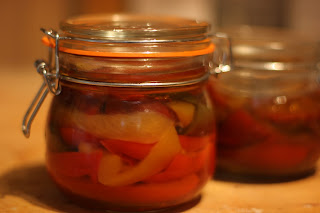
Lamb Chops with Pickled Peppers
2 lamb chops, rib or loin, whichever you prefer. I've used rib, as I think they're more elegant and they also have more fat on them.
2 pickled peppers
1 tin of borlotti beans
2 tbs mint sauce
Trim any extra fat (beyond the amount you want!) off the lamb chops. Score the remaining fat into little diamonds so that it will crisp up well. Drain and rinse the borlotti beans. Drain the pickled peppers and slice into strips.
Heat a small frying pan until very hot, and then place the lamb chops in, fat-side down. Fry for a couple of minutes until the fat is crisping up well and coloured deep golden.
Meanwhile, heat a little olive oil in a small saucepan, and tip in the beans, peppers, and the mint sauce. Pop on a lid and leave over a medium heat to warm through.

Flip the lamb chops onto one side and fry for about 1 minute 30 seconds on each side, until browned. This will give you a medium-rare chop; if you prefer your meat well done then give them an extra 30 seconds to a minute per side, lowering the heat to stop the outside from burning.
Tip the bean mixture onto a plate, and top with the lamb chops. Serve with plenty of kitchen roll for mopping the fat and juice off your fingers/face.

Jessica's mother's favourite single dinner was liver, as was my mother's. Usually stroganoffed. Utterly disgusting. However, I did manage to acquire some tastes from my mother. One of the most noticeable is my love of meat-on-the-bone: all the fatty, crispy, over-done or extra-juicy bits that others sneered at. During my vegetarian phases, I rarely miss the meat itself, but I do miss the fat, and the unctuous gloop of proper meat stock.
This is originally one of my Mum's recipes. I think it did get cooked for the family, but I always think of it as her dinner, not our dinner. The rest of us (I admit that my fat and crispy bits adoration came later) politely sawed our way round the bones, peeled off the fat, and left them on the side of the plate. Mum ate the fat and nibbled away at the bones. Here's her handwritten recipe:

I've cut the number of ingredients to make it easier, and less wasteful, to produce for one person. The mushrooms and the sundried tomatoes are gone.

I've also replaced the jar of mixed peppers with some of my homemade pickled peppers. The recipe can be found in Diana Henry's Salt, Sugar, Smoke, which I urge you to buy. I did not count myself as a preserving person (I don't really like jam, for one thing) until I had this book, but now there are jars of all sorts lurking in my cupboards. The pickled peppers are incredibly quick and easy to make, last forever, and go well with all sorts of fatty meats or rich cheeses. But if you don't have any, do as Mum did, and use a couple of peppers from a jar together with some balsamic vinegar.

Lamb Chops with Pickled Peppers
2 lamb chops, rib or loin, whichever you prefer. I've used rib, as I think they're more elegant and they also have more fat on them.
2 pickled peppers
1 tin of borlotti beans
2 tbs mint sauce
Trim any extra fat (beyond the amount you want!) off the lamb chops. Score the remaining fat into little diamonds so that it will crisp up well. Drain and rinse the borlotti beans. Drain the pickled peppers and slice into strips.
Heat a small frying pan until very hot, and then place the lamb chops in, fat-side down. Fry for a couple of minutes until the fat is crisping up well and coloured deep golden.
Meanwhile, heat a little olive oil in a small saucepan, and tip in the beans, peppers, and the mint sauce. Pop on a lid and leave over a medium heat to warm through.

Flip the lamb chops onto one side and fry for about 1 minute 30 seconds on each side, until browned. This will give you a medium-rare chop; if you prefer your meat well done then give them an extra 30 seconds to a minute per side, lowering the heat to stop the outside from burning.
Tip the bean mixture onto a plate, and top with the lamb chops. Serve with plenty of kitchen roll for mopping the fat and juice off your fingers/face.

Wednesday, 11 September 2013
A single breakfast
Breakfast is a key part of our coupledom. Almost without fail, Saturday morning is a lie-in with a cup of tea, then a bacon sandwich and coffee. Sometimes we talk about eating something other than bacon sandwiches - scrambled eggs, sausage sandwiches, waffles maybe - but we never actually do these things. The bacon sandwich is an ingrained ritual.
There are occasions, though, when I'm on my own for breakfast. Weekends when the boyfriend is away, or midweek days off work in the August lull. On these days, I have an entirely different ritual: the croissant and the coffee.
Ideally, this is a summer ritual. To my mind, one of the most calming things in the world is to sit in the morning sunshine, listening to birds and the movement of air and the world starting to shift, with a good croissant and a good coffee in hand.
The coffee part is fairly simple, although it's taken years for me to find my perfect coffee (currently, the Kenyan AA from Cardew's in the Oxford Covered Market, but I'm open to persuasion). It's ground only as and when I need it, in a Krups burr grinder, set to a slightly finer setting than you should use for a cafetiere. I like sludge at the bottom of my coffee. I then pop a heaped dessertspoonful into a small cafetiere, add water about 5 seconds off the boil, and leave for 3 minutes. It then gets decanted, into a large thick Denby mug, with a generous glug of cold milk.
The croissant is harder. Maison Blanc are the best I've found so far. But I've been reading Elizabeth David's English Bread and Yeast Cookery lately, and discovered that croissants are a form of enriched yeast dough puff pastry (I thought they were just puff pastry). And a friend gave me some sourdough starter a couple of months ago. So far, I'd only made bread: but what if I could make my own croissants?
Luckily, I wasn't the first person to have thought of this, although it seemed that most people added either extra yeast, or a chemical raising agent (baking powder/bicarbonate of soda). I did find one pure recipe, though, courtesy of someone called LeadDog at an American sourdough collaborative blog. This is essentially their recipe, with some timing edits and more details on the folding stage.
The easiest way to get your own starter is to ask a friend for some of theirs. If that fails, then you can make your own, but I'm not the person to advise you on that!
Sourdough croissants
For the initial dough:
140g ripe starter (i.e. starter which has been fed recently and is bubbling actively)
280g milk
60g butter (salted/unsalted/whatever's in the fridge)
15g sugar
480g strong white flour
10g salt
Later:
250g unsalted butter
1 egg
Bring the milk to a boil then leave to cool back down to body temperature. When you can dip your finger in, and can't feel the liquid around it, then it's ok. Bring the butter up to room temperature.
Weigh the starter out into a large mixing bowl, then stir in the milk, followed by the butter and sugar. Mix in the flour - at this stage it will be a sticky mess - and then the salt.
Tip the mixture onto a well-floured worktop, and knead for 5 minutes or so. You want a mixture that is holding together well, and which looks smooth even when stretched. Tip this back into the mixing bowl and leave at room temperature overnight, or for around 10 hours. For me, room temperature is about 20 degrees celcius at the moment.
The next morning, take the 250g pack of butter out of the fridge and leave for a couple of hours. Roll it out between two sheets of greaseproof paper until it's about a centimetre thick, then pop it back in the fridge or freezer to harden - this should take around 30 minutes.
Tip the dough onto a well-floured worktop again, and knead very briefly. Roll out to just over twice the size of the sheet of butter - i.e. if you have a square that's 6 inches x 6 inches of butter, you'll need a rectangle of dough around 13 inches by 7 inches. The aim here is to place the butter on half of the rectangle of dough, then fold the remaining half over, sealing in the butter. I hope that makes sense.
Once your butter is safely sealed, gently roll the entire package out until it's about 12 inches x 18 inches. No need to be precise. Then fold the top third of the dough over the middle third, then fold the bottom third over both of these. You're aiming for something like a letter-folding process. The roll the dough out again, and repeat, but this time aim to have the folds at 90 degree to the previous ones, so your layers are going in a different direction. Then pop the parcel back into the fridge for around an hour, to cool the butter and relax the dough. Make a cup of tea and read a couple of chapters of your book.
You can repeat this as many times as you like, until you get bored. I did three pairs of rolling and folds in total, and got fairly good thin laters; I'd definitely consider doing a fourth in future.
Finally, roll the dough out and cut into triangles. You'll need to decide at this point how large you want your croissants. If you want them big (weekend sized), then you're aiming to make eight. For small, weekday, croissants, you're aiming to get twelve. I found the easiest way of doing this was to roll the dough out to as large as my rolling pin permits (around the 12 x 18 inches mentioned earlier, coincidentally), cut it into two or three rectangles, then roll each of these rectangles out again into a square of roughly 12 x 12 inches. Each square can then be cut into four triangles.
I then rolled each triangle out a little more, stretching the tip opposite the longest side. Those of you who enjoyed Pythagorus at school will be having a great time right now. Start rolling up the longest side, up to the tip, then curl the two points round to make a crescent.
Leave the rolled croissants to rise at room temperature for around 4 hours. Heat the oven to 220 degrees celcius.
Mash the egg up, and brush it over the croissants. Mine didn't look very risen at this point, so don't panic. Pop them in the oven for 20-25 minutes and you get these monstrosities:

There are occasions, though, when I'm on my own for breakfast. Weekends when the boyfriend is away, or midweek days off work in the August lull. On these days, I have an entirely different ritual: the croissant and the coffee.
Ideally, this is a summer ritual. To my mind, one of the most calming things in the world is to sit in the morning sunshine, listening to birds and the movement of air and the world starting to shift, with a good croissant and a good coffee in hand.
The coffee part is fairly simple, although it's taken years for me to find my perfect coffee (currently, the Kenyan AA from Cardew's in the Oxford Covered Market, but I'm open to persuasion). It's ground only as and when I need it, in a Krups burr grinder, set to a slightly finer setting than you should use for a cafetiere. I like sludge at the bottom of my coffee. I then pop a heaped dessertspoonful into a small cafetiere, add water about 5 seconds off the boil, and leave for 3 minutes. It then gets decanted, into a large thick Denby mug, with a generous glug of cold milk.
The croissant is harder. Maison Blanc are the best I've found so far. But I've been reading Elizabeth David's English Bread and Yeast Cookery lately, and discovered that croissants are a form of enriched yeast dough puff pastry (I thought they were just puff pastry). And a friend gave me some sourdough starter a couple of months ago. So far, I'd only made bread: but what if I could make my own croissants?
Luckily, I wasn't the first person to have thought of this, although it seemed that most people added either extra yeast, or a chemical raising agent (baking powder/bicarbonate of soda). I did find one pure recipe, though, courtesy of someone called LeadDog at an American sourdough collaborative blog. This is essentially their recipe, with some timing edits and more details on the folding stage.
The easiest way to get your own starter is to ask a friend for some of theirs. If that fails, then you can make your own, but I'm not the person to advise you on that!
Sourdough croissants
For the initial dough:
140g ripe starter (i.e. starter which has been fed recently and is bubbling actively)
280g milk
60g butter (salted/unsalted/whatever's in the fridge)
15g sugar
480g strong white flour
10g salt
Later:
250g unsalted butter
1 egg
Bring the milk to a boil then leave to cool back down to body temperature. When you can dip your finger in, and can't feel the liquid around it, then it's ok. Bring the butter up to room temperature.
Weigh the starter out into a large mixing bowl, then stir in the milk, followed by the butter and sugar. Mix in the flour - at this stage it will be a sticky mess - and then the salt.
Tip the mixture onto a well-floured worktop, and knead for 5 minutes or so. You want a mixture that is holding together well, and which looks smooth even when stretched. Tip this back into the mixing bowl and leave at room temperature overnight, or for around 10 hours. For me, room temperature is about 20 degrees celcius at the moment.
The next morning, take the 250g pack of butter out of the fridge and leave for a couple of hours. Roll it out between two sheets of greaseproof paper until it's about a centimetre thick, then pop it back in the fridge or freezer to harden - this should take around 30 minutes.
Tip the dough onto a well-floured worktop again, and knead very briefly. Roll out to just over twice the size of the sheet of butter - i.e. if you have a square that's 6 inches x 6 inches of butter, you'll need a rectangle of dough around 13 inches by 7 inches. The aim here is to place the butter on half of the rectangle of dough, then fold the remaining half over, sealing in the butter. I hope that makes sense.
Once your butter is safely sealed, gently roll the entire package out until it's about 12 inches x 18 inches. No need to be precise. Then fold the top third of the dough over the middle third, then fold the bottom third over both of these. You're aiming for something like a letter-folding process. The roll the dough out again, and repeat, but this time aim to have the folds at 90 degree to the previous ones, so your layers are going in a different direction. Then pop the parcel back into the fridge for around an hour, to cool the butter and relax the dough. Make a cup of tea and read a couple of chapters of your book.
You can repeat this as many times as you like, until you get bored. I did three pairs of rolling and folds in total, and got fairly good thin laters; I'd definitely consider doing a fourth in future.
Finally, roll the dough out and cut into triangles. You'll need to decide at this point how large you want your croissants. If you want them big (weekend sized), then you're aiming to make eight. For small, weekday, croissants, you're aiming to get twelve. I found the easiest way of doing this was to roll the dough out to as large as my rolling pin permits (around the 12 x 18 inches mentioned earlier, coincidentally), cut it into two or three rectangles, then roll each of these rectangles out again into a square of roughly 12 x 12 inches. Each square can then be cut into four triangles.
I then rolled each triangle out a little more, stretching the tip opposite the longest side. Those of you who enjoyed Pythagorus at school will be having a great time right now. Start rolling up the longest side, up to the tip, then curl the two points round to make a crescent.
Leave the rolled croissants to rise at room temperature for around 4 hours. Heat the oven to 220 degrees celcius.
Mash the egg up, and brush it over the croissants. Mine didn't look very risen at this point, so don't panic. Pop them in the oven for 20-25 minutes and you get these monstrosities:

Friday, 5 July 2013
Pasta Pesto
I am reliably informed that, before my sister moved in, my recently-acquired brother-in-law ate pasta and pesto every night for dinner. I'm taking that as in indication that it is the quintessential single person food, and hence a massive omission from this blog.
Pasta with a spoonful of pesto stirred through is now so mainstream that the word "and" can safely be elided from its title without any confusion. But it's not exactly a recipe, it is? Hardly worthy of a blog post, and somehow unrewarding: no achievement, no nourishment, a vegetable oil lake left at the bottom of the bowl.
Having recently returned from a fortnight in Sicily, I determined to try harder. Homemade pesto was the way forward. And, having committed, I was shocked to find it's really easy. You can bash up a portion in significantly less time than it takes to actually boil the pasta.
Real pesto
I think everyone has very personal tastes in what they want in a pesto. I like garlic.
1 small clove of garlic, or half a big clove
50g basil
25g pine nuts
2 tbs or so of good quality extra virgin olive oil
25g parmesan
100g spaghetti, to serve.
Put the spaghetti on to cook. Toast the pinenuts until lightly browned all over, and put to one side to cool.
First pop your garlic clove in a big mortar, add a large pinch of salt, then crush to a paste. Next, add your basil leaves (you'll probably have to do this in a few batches) and likewise crush. Third, pop in your cooled pine nuts, and crush lightly - a few little bits of nut in the smooth paste are quite nice, I find.
I am being very strict about the order here. If you add them in a different order your basil won't crush properly, so do be careful.
Stir in the olive oil, adding more if needed, so that you have a loose paste but one that doesn't seperate out if left for a few seconds.
Grate the parmesan and stir in.
Drain the pasta, keeping a decent few spoonfuls of water, and return to the saucepan. Tip in the pesto and lift (in a salad tossing manner) to coat each strand.
Pasta with a spoonful of pesto stirred through is now so mainstream that the word "and" can safely be elided from its title without any confusion. But it's not exactly a recipe, it is? Hardly worthy of a blog post, and somehow unrewarding: no achievement, no nourishment, a vegetable oil lake left at the bottom of the bowl.
Having recently returned from a fortnight in Sicily, I determined to try harder. Homemade pesto was the way forward. And, having committed, I was shocked to find it's really easy. You can bash up a portion in significantly less time than it takes to actually boil the pasta.
Real pesto
I think everyone has very personal tastes in what they want in a pesto. I like garlic.
1 small clove of garlic, or half a big clove
50g basil
25g pine nuts
2 tbs or so of good quality extra virgin olive oil
25g parmesan
100g spaghetti, to serve.
Put the spaghetti on to cook. Toast the pinenuts until lightly browned all over, and put to one side to cool.
First pop your garlic clove in a big mortar, add a large pinch of salt, then crush to a paste. Next, add your basil leaves (you'll probably have to do this in a few batches) and likewise crush. Third, pop in your cooled pine nuts, and crush lightly - a few little bits of nut in the smooth paste are quite nice, I find.
I am being very strict about the order here. If you add them in a different order your basil won't crush properly, so do be careful.
Stir in the olive oil, adding more if needed, so that you have a loose paste but one that doesn't seperate out if left for a few seconds.
Grate the parmesan and stir in.
Drain the pasta, keeping a decent few spoonfuls of water, and return to the saucepan. Tip in the pesto and lift (in a salad tossing manner) to coat each strand.
Thursday, 4 July 2013
Top Ten in Oxford 2013
A year between posts, and this one isn't even a recipe.
Another Oxford-based food blogger recently published a list of his top ten restaurants in Oxford this year. I disagreed with his choices and so I was challenged to come up with my own list. I disagree in principle with the concept of "top tens": there's a compunction to include places that might be slightly sub-par simply to make up numbers. High Fidelity is an excellent lesson in this respect: top tens are used as a substitute for real conversation; as the film progresses and the narrator's situation becomes more serious, the top tens become less and less important, and real conversations become properly valued.
On top of that the ranking system often isn't explained. Are they personal favourites? Are they best for food, or for service, or for atmosphere? Or are they simply near to the writer's home, and therefore convenient? For me, a full-length (by which I mean at least 500 words) review will always hold more value than a headline-grabbing top ten.
That said, here are my favourites:
Al Shami
The best Lebanese in Oxford, and one that (in my fairly wide experience) could definitely compete at a national level. Particularly impressive is the wide range of vegetarian meze, as well as their bravery in putting some less traditional meats on the menu. I haven't dared try the brains yet, but the raw lamb kibbeh nayeh is excellent: refreshing and delicate in an unexpected manner.
Atomic Burgers
As far as I'm aware, the only restaurant (now a mini chain!) in the country where the focus is on what goes on top of the burger. There's a rash of Gourmet Burgers/Byrons, and now London is even facing the invasion of New York's Shake Shack, but Atomic are merrily carving a path of their own. It's also great fun: popping candy in your milkshake; Thunderbirds videos on the wall; burgers names after 1980s film characters...
Chiang Mai Kitchen
I nearly excluded Chiang Mai on price grounds: I never really feel I'm quite getting value for money here.That said, the food is mostly authentic, some is excellent, and all is well-spiced. It's served in the delightful setting of an Elizabethan townhouse and ex-prison, creating an intimate atmosphere, and it even has a decent wine list.
Door 74
If I ever decide to open a restaurant, it would be very like Door 74. There's a reassuringly short menu, making it clear that all the food is cooked from scratch for each individual order, rather than being pre-prepped then re-heated or "finished" on demand. It's also one of the most romantic places I know for dinner, with its twinkly lights, small size, and unobtrusive service. It's also stupidly cheap.
Magdalen Arms
I avoided the Magdalen Arms for ages, disliking the amount of hype it had received, mostly from London-based writers and bloggers. Unfortunately, when I finally visited, it turned out to be as good as they'd all said. The Magdalen Arms can easily compete with the London gastropub scene both in terms of the innovatativeness and the flavour of the food, as it should given it's run by the folk behind "the first gastropub" in the UK, the Anchor and Hope. The sharing dishes are always particularly interesting.
My Sichuan
Intestines. Ears. Tongues. Oh, and last time I glimpsed into the kitchen they had entire storage boxes filled with dried chillis. Somehow, out of all that, have come some of the most interesting, exciting, and downright delicious meals I've ever eaten. It's not for the fainthearted, but if you're bored with lemon chicken and beef in black bean sauce, come here for some real Chinese food. The flavours will knock you backwards, pump you full of endorphins, and then soothe you back with delicious meaty fattiness.
Rickety Press
The Rickety Press calls itself a gastropub, but both the food and the greenhouse setting are far too elegant for that label in my view. There are some standards here (onion and goat's cheese tarts, burgers, fishcakes) but also some more ambitious dishes, all in a fairly modern British range. Everything, though, is cooked with an exacting precision and presented stylishly.
Sojo
If My Sichuan sounds a bit too much for you, then Sojo might be just right: still pushing boundaries but with a few more recognisable dishes. The service here is excellent, and the waiting staff are experts in identifying a customer's comfort zone, then pushing them to order something just a little bit more different, to surprise and delight them.
Turl Street Kitchen
TSK, together with Oxfork (mentioned below) and now the St Giles' Cafe (also mentioned below) is at the forefront of a new hyperlocal trend in eating out, which in my view is unmatched almost anywhere else in the UK. That was reflected in the view that the Sustainable Restaurant Association took when asked to review TSK by Giles Coren. On top of all that, the food is in line with the latest trend for nose-to-tail eating. Oh, and it tastes really good.
Yeti
I'm really sad that there isn't an Indian restaurant on this list. Oxford has plenty of good Indian restaurants, but nothing that stands out from the crowd, and definitely nothing that could compete with, say, Birmingham or Leicester. But we've recently acquired a rash of something else from the subcontinent: Nepalese restaurants. It all started with Everest (which doesn't appear here for the simple reason that I haven't eaten there!), and we now also have Yeti and Kadai&Naan. The flavours are really interesting, playing a lot more in the bittersweet/aniseedy range, and using a lot more dried spices than normal Indian food. Yeti also has the most welcoming service I have ever encountered.
And finally, three who didn't make it into the list because they're not quite traditional restaurants:
Olives
Best sandwiches in Oxford. They're not cheap, but then when your baguette contains an entire ball of buffalo mozzarella, who's complaining?
Oxfork
Best breakfast (to be accurate, by the time I get out of bed, it's more like brunch) in Oxford. As with TSK, hyperlocal sourcing combined with good British food traditions. The range of veggie options is particularly welcome.
Pukeko
Best coffee in Oxford - and it's a tough field. This is a very personal choice, as everyone likes a slightly different flavour to their coffee. Honourable mentions also go to Zappi's, Quarter Horse, and Missing Bean.
And one more who I suspect will make this list next year, once they're fully up and running with a regular menu and regular evening opening: St Giles' Cafe. The owner has really done his research, spending time working in several Oxford restaurants and discovering some of our best suppliers, before setting up on his own. Particularly of note is that they make all their own bacon and sausages - and you can tell.
Another Oxford-based food blogger recently published a list of his top ten restaurants in Oxford this year. I disagreed with his choices and so I was challenged to come up with my own list. I disagree in principle with the concept of "top tens": there's a compunction to include places that might be slightly sub-par simply to make up numbers. High Fidelity is an excellent lesson in this respect: top tens are used as a substitute for real conversation; as the film progresses and the narrator's situation becomes more serious, the top tens become less and less important, and real conversations become properly valued.
On top of that the ranking system often isn't explained. Are they personal favourites? Are they best for food, or for service, or for atmosphere? Or are they simply near to the writer's home, and therefore convenient? For me, a full-length (by which I mean at least 500 words) review will always hold more value than a headline-grabbing top ten.
That said, here are my favourites:
Al Shami
The best Lebanese in Oxford, and one that (in my fairly wide experience) could definitely compete at a national level. Particularly impressive is the wide range of vegetarian meze, as well as their bravery in putting some less traditional meats on the menu. I haven't dared try the brains yet, but the raw lamb kibbeh nayeh is excellent: refreshing and delicate in an unexpected manner.
Atomic Burgers
As far as I'm aware, the only restaurant (now a mini chain!) in the country where the focus is on what goes on top of the burger. There's a rash of Gourmet Burgers/Byrons, and now London is even facing the invasion of New York's Shake Shack, but Atomic are merrily carving a path of their own. It's also great fun: popping candy in your milkshake; Thunderbirds videos on the wall; burgers names after 1980s film characters...
Chiang Mai Kitchen
I nearly excluded Chiang Mai on price grounds: I never really feel I'm quite getting value for money here.That said, the food is mostly authentic, some is excellent, and all is well-spiced. It's served in the delightful setting of an Elizabethan townhouse and ex-prison, creating an intimate atmosphere, and it even has a decent wine list.
Door 74
If I ever decide to open a restaurant, it would be very like Door 74. There's a reassuringly short menu, making it clear that all the food is cooked from scratch for each individual order, rather than being pre-prepped then re-heated or "finished" on demand. It's also one of the most romantic places I know for dinner, with its twinkly lights, small size, and unobtrusive service. It's also stupidly cheap.
Magdalen Arms
I avoided the Magdalen Arms for ages, disliking the amount of hype it had received, mostly from London-based writers and bloggers. Unfortunately, when I finally visited, it turned out to be as good as they'd all said. The Magdalen Arms can easily compete with the London gastropub scene both in terms of the innovatativeness and the flavour of the food, as it should given it's run by the folk behind "the first gastropub" in the UK, the Anchor and Hope. The sharing dishes are always particularly interesting.
My Sichuan
Intestines. Ears. Tongues. Oh, and last time I glimpsed into the kitchen they had entire storage boxes filled with dried chillis. Somehow, out of all that, have come some of the most interesting, exciting, and downright delicious meals I've ever eaten. It's not for the fainthearted, but if you're bored with lemon chicken and beef in black bean sauce, come here for some real Chinese food. The flavours will knock you backwards, pump you full of endorphins, and then soothe you back with delicious meaty fattiness.
Rickety Press
The Rickety Press calls itself a gastropub, but both the food and the greenhouse setting are far too elegant for that label in my view. There are some standards here (onion and goat's cheese tarts, burgers, fishcakes) but also some more ambitious dishes, all in a fairly modern British range. Everything, though, is cooked with an exacting precision and presented stylishly.
Sojo
If My Sichuan sounds a bit too much for you, then Sojo might be just right: still pushing boundaries but with a few more recognisable dishes. The service here is excellent, and the waiting staff are experts in identifying a customer's comfort zone, then pushing them to order something just a little bit more different, to surprise and delight them.
Turl Street Kitchen
TSK, together with Oxfork (mentioned below) and now the St Giles' Cafe (also mentioned below) is at the forefront of a new hyperlocal trend in eating out, which in my view is unmatched almost anywhere else in the UK. That was reflected in the view that the Sustainable Restaurant Association took when asked to review TSK by Giles Coren. On top of all that, the food is in line with the latest trend for nose-to-tail eating. Oh, and it tastes really good.
Yeti
I'm really sad that there isn't an Indian restaurant on this list. Oxford has plenty of good Indian restaurants, but nothing that stands out from the crowd, and definitely nothing that could compete with, say, Birmingham or Leicester. But we've recently acquired a rash of something else from the subcontinent: Nepalese restaurants. It all started with Everest (which doesn't appear here for the simple reason that I haven't eaten there!), and we now also have Yeti and Kadai&Naan. The flavours are really interesting, playing a lot more in the bittersweet/aniseedy range, and using a lot more dried spices than normal Indian food. Yeti also has the most welcoming service I have ever encountered.
And finally, three who didn't make it into the list because they're not quite traditional restaurants:
Olives
Best sandwiches in Oxford. They're not cheap, but then when your baguette contains an entire ball of buffalo mozzarella, who's complaining?
Oxfork
Best breakfast (to be accurate, by the time I get out of bed, it's more like brunch) in Oxford. As with TSK, hyperlocal sourcing combined with good British food traditions. The range of veggie options is particularly welcome.
Pukeko
Best coffee in Oxford - and it's a tough field. This is a very personal choice, as everyone likes a slightly different flavour to their coffee. Honourable mentions also go to Zappi's, Quarter Horse, and Missing Bean.
And one more who I suspect will make this list next year, once they're fully up and running with a regular menu and regular evening opening: St Giles' Cafe. The owner has really done his research, spending time working in several Oxford restaurants and discovering some of our best suppliers, before setting up on his own. Particularly of note is that they make all their own bacon and sausages - and you can tell.
Friday, 17 August 2012
One (or two) courgette dinners
I'm back at my parents' for a few days, cat (and house) sitting whilst they're away. At this time of year, that can mean only one thing: courgette flowers for dinner. I tried to grow my own plant this year but it remains a scrawny little runt, and I'm beginning to doubt that it will ever produce anything edible.
So I seized the opportunity for some courgette consumption tonight with a homegrown two-course dinner. Either one of these dishes, on its own with a salad or a pudding (or both) would easily make a good dinner. I ate both.
Stuffed courgette flowers
You can find a million recipes for stuffed courgette flowers on t'internet, so for some time I doubted the need to give you one at all. I'd also encourage you to experiment with various different fillings until you find your favourite. That said, I'll always go for the near-instant herb and cheese mixtures over risotto (who ever has leftovers when they make risotto?) or crab, which I tend not to have hanging around in my fridge waiting for a courgette flower to blossom.
Here's my favourite combo:
2 courgette flowers
3 tbs grated parmesan
grated zest of half a lemon, plus a teeny squeeze of juice
1 tbs finely chopped mint
1 tbs cornflour
1 egg white
Combine the parmesan, lemon zest, and mint, adding just enough lemon juice to get it into a sticky paste. Very, very delicately open up the courgette flowers and, using a teaspoon, slide the stuffing in. Push the petals back together then twist them together at the top to seal in the stuffing.
In a bowl large enough to fit both stuffed flowers, whisk together the cornflour and egg white. Dip the flowers in and gently turn with your hands to get them coated all over.
Heat a generous layer of oil in a frying pan and heat until a spot of batter, dripped in, sizzles immediately. Place the flowers in. They'll need turning round probably twice, to get all sides crispy - they tend to need two minutes per side but just check and flip when the batter gets golden.
Remove to a piece of kitchen roll to drain, then serve. Best eaten with fingers.
Roasted courgette and feta
I've recently twigged that several supermarkets (well, Sainsbury's and Waitrose, at least) do half-size tins of tomatoes. What fabulous news for single cooks! No more half open tins growing new life forms at the back of the fridge.
1 large (or two smaller) courgette
small tin tomatoes
100g feta
Slice the courgette into thick rounds, toss with a drizzle of oil, and roast for 20 minutes at 220 degrees until starting to brown round the edges. Tip in the tin of tomatoes and crumble over the feta. Return to the oven for a further 10 minutes, or until the feta is starting to brown.
Remove from the oven and leave to cool slightly. Serve with crusty bread for dunking, and maybe a few salad leaves.
So I seized the opportunity for some courgette consumption tonight with a homegrown two-course dinner. Either one of these dishes, on its own with a salad or a pudding (or both) would easily make a good dinner. I ate both.
Stuffed courgette flowers
You can find a million recipes for stuffed courgette flowers on t'internet, so for some time I doubted the need to give you one at all. I'd also encourage you to experiment with various different fillings until you find your favourite. That said, I'll always go for the near-instant herb and cheese mixtures over risotto (who ever has leftovers when they make risotto?) or crab, which I tend not to have hanging around in my fridge waiting for a courgette flower to blossom.
Here's my favourite combo:
2 courgette flowers
3 tbs grated parmesan
grated zest of half a lemon, plus a teeny squeeze of juice
1 tbs finely chopped mint
1 tbs cornflour
1 egg white
Combine the parmesan, lemon zest, and mint, adding just enough lemon juice to get it into a sticky paste. Very, very delicately open up the courgette flowers and, using a teaspoon, slide the stuffing in. Push the petals back together then twist them together at the top to seal in the stuffing.
In a bowl large enough to fit both stuffed flowers, whisk together the cornflour and egg white. Dip the flowers in and gently turn with your hands to get them coated all over.
Heat a generous layer of oil in a frying pan and heat until a spot of batter, dripped in, sizzles immediately. Place the flowers in. They'll need turning round probably twice, to get all sides crispy - they tend to need two minutes per side but just check and flip when the batter gets golden.
Remove to a piece of kitchen roll to drain, then serve. Best eaten with fingers.
Roasted courgette and feta
I've recently twigged that several supermarkets (well, Sainsbury's and Waitrose, at least) do half-size tins of tomatoes. What fabulous news for single cooks! No more half open tins growing new life forms at the back of the fridge.
1 large (or two smaller) courgette
small tin tomatoes
100g feta
Slice the courgette into thick rounds, toss with a drizzle of oil, and roast for 20 minutes at 220 degrees until starting to brown round the edges. Tip in the tin of tomatoes and crumble over the feta. Return to the oven for a further 10 minutes, or until the feta is starting to brown.
Remove from the oven and leave to cool slightly. Serve with crusty bread for dunking, and maybe a few salad leaves.
Saturday, 5 May 2012
The Gastropub
I am the target market for gastropubs. I know this because a man from Young's, the brewers and pub chain, once said to me "Katy, you're the target market for gastropubs" before giving me £30 to talk for an hour about what I like to see in a gastropub. So why is it that I never actually seem to like them?
I can just about remember the days before gastropubs had spread like a rash across city centres, although by the time I could legally drink there were very few places left where it was impossible to get a decent glass of wine in a pub. Unreconstructed personal favourites are my first local, The Harrow Inn (my god: they now have a website) and until recently the Harcourt Arms in Jericho (website, or for the story of its recent change see the Daily Info reviews). I knew I'd never get a decent drink in them, but I loved them all the same.
What I don't love is snooty service, "dining areas" which seem to consist of the entire pub less a single sofa, and sub-standard food. The Red Lion didn't get itself off onto the right foot with me the first time I dropped in, at around 10.30 on a Wednesday night, and settled down at a table only to be told I was in the dining area and would have to move. Given the pub was nearly empty, and the kitchen had closed for the night, I intended never to return. But a group of colleagues adopted it as a Friday after-work venue, and so I've been in a few times since and had a few glasses of nice wine; so, when I needed a quick bite in the Gloucester Green vicinity last week, I had no qualms about trying them out.
It began so well, with a very friendly waiter showing us to a delightful beige-carpeted mezzanine section of the dining area. Extra bonus points were gained for nailing me as a Viognier-drinker and instantly recommending a bottle from the list. There's also an excellent range of beers on offer, both trad real ales and some interesting European wheat beers. The menu looked interesting, and I want to love any place that does scallops of the day, though if those scallops of the day are curried, with a pineapple and celeriac salad, I'm less tempted. We really just wanted some fast comfort food, so one of us went for the gammon, egg, and chips (or Maple Spit Gammon, Hen's Egg, and Frites, as the menu would prefer), one for a vegetable pizza, and two of us (including me) chose the cannelloni, probably because amongst fifteen non-pizza main dishes, it was the only vegetarian option. So, let's start with the positive: the pizza toppings were generous and reportedly tasty.
I realise that in any food outlet serving sixteen different mains, nine pizzas, nine starters, eight sharing starters, and nine "for the tables", a certain amount of re-heating and packet food is going to have to occur. But I do object when the phrase "al forno" is used on the menu when "al microwave" has clearly been used on my plate. There's a certain kind of skin that forms on a white sauce under the influence of electronic zaps, and it isn't a nice one. We were also disappointed not to find any of the promised butternut within the dish. Spinach and ricotta cannelloni is nice, but it isn't what we were sold. It might not be entirely fair to ask the world's biggest ham-egg-and-chips fan to review The Red Lion, but he was also underwhelmed, by an over-cooked egg and over-cooked chips (sorry: frites).
The Red Lion clearly do wine and beer very well, and since my first visit also seem to have excellent serving staff. They might do a lot better if they focussed more on these pub elements and less on the gastro.
One place I don't mind focussing on the gastro, though, is The Black Boy in Headington. There, the problem lies distinctly with the service, where they still don't understand that if the kitchen has closed, it might be ok to let drinkers sit in the "dining area". Last time I visited they claimed we wouldn't be able to use a table "because they were already set up for tomorrow's lunch service". They relented under some pressure, but I object to having to argue for a table every time I want a couple of glasses of wine.
However: the food is superb. It is pricier than most pubs, and has a more restricted menu (nine starters, eleven mains) but this is reflected in the quality both of the ingredients and of the care taken in the kitchen. I've eaten there on several occasions with a large group of friends and have yet to hear a complaint about the food. Personally, I've sampled the gravadlax and the beetroot and feta salad starters, and have also had their bavette steak frites - an underused cut which needs to be handled carefully, and it was when I had it - and the mushroom and spinach cannelloni. We established earlier that this was a dish all-too-tempting to be lazy with, but at The Black Boy I had one of the richest and most delicious versions I've ever had.
There's something to be said for any company who keep pubs making profits in the current economic climate, but I do worry that, once we all get over our excitement about the nice carpets and the nice wine list, they'll go to the same end. And with plenty of people out there in Oxford doing good gastropubbiness, like The Rickety Press (reviewed by Girl Eats Oxford, also featuring her thoughts on gastropubs), their sister pub The Rusty Bicycle, and regular haunt of mine, The Royal Oak, it might be time for others to try and meet the same standards.
I can just about remember the days before gastropubs had spread like a rash across city centres, although by the time I could legally drink there were very few places left where it was impossible to get a decent glass of wine in a pub. Unreconstructed personal favourites are my first local, The Harrow Inn (my god: they now have a website) and until recently the Harcourt Arms in Jericho (website, or for the story of its recent change see the Daily Info reviews). I knew I'd never get a decent drink in them, but I loved them all the same.
What I don't love is snooty service, "dining areas" which seem to consist of the entire pub less a single sofa, and sub-standard food. The Red Lion didn't get itself off onto the right foot with me the first time I dropped in, at around 10.30 on a Wednesday night, and settled down at a table only to be told I was in the dining area and would have to move. Given the pub was nearly empty, and the kitchen had closed for the night, I intended never to return. But a group of colleagues adopted it as a Friday after-work venue, and so I've been in a few times since and had a few glasses of nice wine; so, when I needed a quick bite in the Gloucester Green vicinity last week, I had no qualms about trying them out.
It began so well, with a very friendly waiter showing us to a delightful beige-carpeted mezzanine section of the dining area. Extra bonus points were gained for nailing me as a Viognier-drinker and instantly recommending a bottle from the list. There's also an excellent range of beers on offer, both trad real ales and some interesting European wheat beers. The menu looked interesting, and I want to love any place that does scallops of the day, though if those scallops of the day are curried, with a pineapple and celeriac salad, I'm less tempted. We really just wanted some fast comfort food, so one of us went for the gammon, egg, and chips (or Maple Spit Gammon, Hen's Egg, and Frites, as the menu would prefer), one for a vegetable pizza, and two of us (including me) chose the cannelloni, probably because amongst fifteen non-pizza main dishes, it was the only vegetarian option. So, let's start with the positive: the pizza toppings were generous and reportedly tasty.
I realise that in any food outlet serving sixteen different mains, nine pizzas, nine starters, eight sharing starters, and nine "for the tables", a certain amount of re-heating and packet food is going to have to occur. But I do object when the phrase "al forno" is used on the menu when "al microwave" has clearly been used on my plate. There's a certain kind of skin that forms on a white sauce under the influence of electronic zaps, and it isn't a nice one. We were also disappointed not to find any of the promised butternut within the dish. Spinach and ricotta cannelloni is nice, but it isn't what we were sold. It might not be entirely fair to ask the world's biggest ham-egg-and-chips fan to review The Red Lion, but he was also underwhelmed, by an over-cooked egg and over-cooked chips (sorry: frites).
The Red Lion clearly do wine and beer very well, and since my first visit also seem to have excellent serving staff. They might do a lot better if they focussed more on these pub elements and less on the gastro.
One place I don't mind focussing on the gastro, though, is The Black Boy in Headington. There, the problem lies distinctly with the service, where they still don't understand that if the kitchen has closed, it might be ok to let drinkers sit in the "dining area". Last time I visited they claimed we wouldn't be able to use a table "because they were already set up for tomorrow's lunch service". They relented under some pressure, but I object to having to argue for a table every time I want a couple of glasses of wine.
However: the food is superb. It is pricier than most pubs, and has a more restricted menu (nine starters, eleven mains) but this is reflected in the quality both of the ingredients and of the care taken in the kitchen. I've eaten there on several occasions with a large group of friends and have yet to hear a complaint about the food. Personally, I've sampled the gravadlax and the beetroot and feta salad starters, and have also had their bavette steak frites - an underused cut which needs to be handled carefully, and it was when I had it - and the mushroom and spinach cannelloni. We established earlier that this was a dish all-too-tempting to be lazy with, but at The Black Boy I had one of the richest and most delicious versions I've ever had.
There's something to be said for any company who keep pubs making profits in the current economic climate, but I do worry that, once we all get over our excitement about the nice carpets and the nice wine list, they'll go to the same end. And with plenty of people out there in Oxford doing good gastropubbiness, like The Rickety Press (reviewed by Girl Eats Oxford, also featuring her thoughts on gastropubs), their sister pub The Rusty Bicycle, and regular haunt of mine, The Royal Oak, it might be time for others to try and meet the same standards.
Monday, 30 April 2012
Food for Hipsters
Last weekend, I went to my local independent record store and bought an Record Store Day exclusive single (in see-through vinyl, natch) from a singer recommended to me by Vogue. I caught myself admiring someone's skinny red trousers in a meeting a fortnight ago. I've used a moleskine as my notebook-of-choice for some years. And after that vinyl-purchasing episode, I went to my local farmers' market and bought local vegetables you won't have heard of.
It's just about enough to make me qualify for hipster-status.
As I'm close, I may as well go all the way and cook some hipster food. Here are two great, quick pasta suppers (are we allowed to say supper now that David Cameron has used it? Should I call it tea instead?) which are sufficiently "authentic" and obscure to impress even those friends who possess no clothes other than checked shirts. Each serves two.
Smoked trout and sorrel
Smoked trout is just like smoked salmon, except without the complex ethical considerations (wild destroys stocks, farmed is diseased, organic is unethical behaviour towards my wallet). At least, the stuff I bought at my local farmers' market is. I can't promise anything if you shop at Tesco. Sorrel is a lemony-flavoured version of spinach, so in dire straits you can use spinach instead and add the juice of half a lemon to the sauce.
This would also be great with another hipster ingredient, a handful of wild garlic, added at the same time as the sorrel. Just don't mention that your "foraging" of it consisted of a stroll to the end of Mummy and Daddy's garden.*
150g pasta
120g cold-smoked trout
two large handfuls sorrel leaves
200ml tub creme fraiche
Put the pasta on to boil. Very roughly chop the trout into ribbons, and the sorrel likewise. Once the pasta is cooked, drain and combine all the ingredients.
*It was raining, ok? And cold. I had to wear a raincoat in a non-ironic way. If that doesn't qualify as foraging, what does?
PS. For a really awesome take-down of the latest foodie trends (minus any actually quite tasty recipes), see this press release for a new restaurant on twitter.
It's just about enough to make me qualify for hipster-status.
As I'm close, I may as well go all the way and cook some hipster food. Here are two great, quick pasta suppers (are we allowed to say supper now that David Cameron has used it? Should I call it tea instead?) which are sufficiently "authentic" and obscure to impress even those friends who possess no clothes other than checked shirts. Each serves two.
Smoked trout and sorrel
Smoked trout is just like smoked salmon, except without the complex ethical considerations (wild destroys stocks, farmed is diseased, organic is unethical behaviour towards my wallet). At least, the stuff I bought at my local farmers' market is. I can't promise anything if you shop at Tesco. Sorrel is a lemony-flavoured version of spinach, so in dire straits you can use spinach instead and add the juice of half a lemon to the sauce.
This would also be great with another hipster ingredient, a handful of wild garlic, added at the same time as the sorrel. Just don't mention that your "foraging" of it consisted of a stroll to the end of Mummy and Daddy's garden.*
150g pasta
120g cold-smoked trout
two large handfuls sorrel leaves
200ml tub creme fraiche
Put the pasta on to boil. Very roughly chop the trout into ribbons, and the sorrel likewise. Once the pasta is cooked, drain and combine all the ingredients.
*It was raining, ok? And cold. I had to wear a raincoat in a non-ironic way. If that doesn't qualify as foraging, what does?
'Nduja and PSB
This is great because it contains one ingredient which no-one will have heard of, and one which has an abbreviated codename. 'Nduja is a spicy salami, created so soft that it is spreadable and melts when heated. You can bring some back from your agroturismo week in Calabria, or in emergencies you can get it from Ocado. Chorizo would give you the same flavour, but a totally different texture.
Purple Sprouting Broccoli has a higher proportion of stem to fluff than normal broccoli, so is ideal for pasta dishes where you need some structure to your vegetables. It's also one of the first British vegetables to come into season each spring, so do go out and buy some rather than shipping Tenderstem (TM) in from Spain or wherever.
150g pasta (wholewheat works well here)
1 onion
120g 'nduja
200g purple sprouting broccoli
2 tbs double cream
Put the pasta on to boil, and finely chop the onion. Saute the onion in a decent amount of oil until it softens and starts to brown. Cut each purple sprouting stem in half, and halfway through the pasta cooking time, add it to the water. Just before the pasta and purple sprouting is done, add the 'nduja to the onion pan and leave to melt in the heat, giving it a squish with a spoon to encourage it.
Drain the pasta and purple sprouting, add to the onion/'nduja pan, and drizzle over the cream. Stir well to combine.
PS. For a really awesome take-down of the latest foodie trends (minus any actually quite tasty recipes), see this press release for a new restaurant on twitter.
Monday, 23 April 2012
Pasta Primavera
The cherry blossoms on the tree outside my house lasted about three days before being destroyed by hail on Saturday. I shouldn't be so depressed; we've already eaten Sunday lunch outside twice this year; the sun is high enough that I've squeezed a post-work G&T into the tiny terrace outside the back door, and on Sunday I somehow fitted a coffee and croissant into the light between the showers.
I've also been enjoying the first spring vegetables, sprouting broccoli and asparagus in particular. And, as ever in the single kitchen, there have been leftovers lurking in the bottom of my fridge for the last week. I had been out after work and hadn't shopped for dinner, so with no other supplies in, pasta primavera it was.
I have to confess that, until I started writing this post, I had no idea that "pasta primavera" was an American invention of the seventies rather than a centuries-old Italian tradition. Minus 10 foodie points. I like to think that this is a bit closer to something you'd eat in Italy - no cream and cornflour, no marinara sauce and herbes de provence, no Philly... just some very lightly cooked vegetables and a little pancetta for seasoning. I also added a chargrilled artichoke from a jar (because I had one in the fridge) and a handful of chopped parsley (ditto), but feel free to ignore these.
Pasta Primavera
75g short pasta (fusilli, penne, etc)
3 stalks asparagus
3 (large) stalks sprouting broccoli, or 6 very weedy stalks
50g frozen peas
50g pancetta
1 or 2 chargrilled jarred artichokes, cut up a bit
handful parsley, chopped
Bring a large pan of water to the boil, and throw in the pasta. Chop up the pancetta into little bits and fry with a drop or two of oil until crispy.
Chop the asparagus and broccoli into pieces roughly the same size as your pasta; once the pasta is two minutes from being cooked throw in the asparagus, broccoli, and frozen peas.
Once cooked, drain the pasta and vegetables and toss with the pancetta and its oil, the artichokes and a spoonful or so of their oil, and the parsley. It shouldn't need any seasoning, but you can grate a little parmesan over if you like.
Eat, convincing yourself that it isn't drizzling outside.
I've also been enjoying the first spring vegetables, sprouting broccoli and asparagus in particular. And, as ever in the single kitchen, there have been leftovers lurking in the bottom of my fridge for the last week. I had been out after work and hadn't shopped for dinner, so with no other supplies in, pasta primavera it was.
I have to confess that, until I started writing this post, I had no idea that "pasta primavera" was an American invention of the seventies rather than a centuries-old Italian tradition. Minus 10 foodie points. I like to think that this is a bit closer to something you'd eat in Italy - no cream and cornflour, no marinara sauce and herbes de provence, no Philly... just some very lightly cooked vegetables and a little pancetta for seasoning. I also added a chargrilled artichoke from a jar (because I had one in the fridge) and a handful of chopped parsley (ditto), but feel free to ignore these.
Pasta Primavera
75g short pasta (fusilli, penne, etc)
3 stalks asparagus
3 (large) stalks sprouting broccoli, or 6 very weedy stalks
50g frozen peas
50g pancetta
1 or 2 chargrilled jarred artichokes, cut up a bit
handful parsley, chopped
Bring a large pan of water to the boil, and throw in the pasta. Chop up the pancetta into little bits and fry with a drop or two of oil until crispy.
Chop the asparagus and broccoli into pieces roughly the same size as your pasta; once the pasta is two minutes from being cooked throw in the asparagus, broccoli, and frozen peas.
Once cooked, drain the pasta and vegetables and toss with the pancetta and its oil, the artichokes and a spoonful or so of their oil, and the parsley. It shouldn't need any seasoning, but you can grate a little parmesan over if you like.
Eat, convincing yourself that it isn't drizzling outside.
Tuesday, 3 April 2012
Asparagus Stuffed Pancakes
Public service announcement: don't try making pancakes with rye flour. Utter disaster. Apparently, its gluten is less elastic than wheat flour, and, also, the bran has a seemingly infinite capacity to absorb liquid. I imagine the same applies to other types of wholewheat flour, though if anyone has succeeded, do let me know.
So, given that disaster, I was quite pleased with tonight's dinner. It was inspired by a recipe I've blogged about before, except with added starch and melted cheese to compensate my body for the hail today.
I made it for two, but the quantities beneath are for one, and you have the added advantage that this gives you an excuse to buy a cute little individual baking dish to both cook and serve it in. Two-purpose cookware: this is basically saving money, not spending it. Additional savings are made on the water and Fairy liquid you would have had to use to wash up a baking dish *and* a plate.
The quantities for the pancakes will make more than you need, but I fail to see "spare pancakes" as a problem.
Asparagus stuffed pancakes
For the pancakes:
125 g plain *white* flour
1 egg
300 ml milk
For the stuffing:
100 ml full-fat creme fraiche (you're baking it, so this isn't the time to be healthy. Unless you want curdled pancakes.)
15 g parsley
10 g dill
10 g chives
1 tsp dijon mustard
4 thick (or 6 skinny?) spears of asparagus
a grating of gruyere, or parmesan, or just cheddar. Or whatever.
Start by making the pancake batter: tip the flour into a large bowl, make a dip in the middle, and crack in the egg. Whisk it gradually in, adding the milk gradually as the mixture gets too thick to whisk. Place to one side to rest.
Steam the asparagus for 2-4 minutes, depending on their thickness. The best way of doing this is to lay them down in a frying pan (to which you have a lid), cover with water, and bring to the boil. Turn the heat off when the spears give way to a knife slid into them, and leave them to cool.
Whilst the asparagus is getting touchable, fry your pancakes. You know how to fry a pancake, right? Tip them onto a flat chopping board and leave until they, too, are touchable.
In the meantime, finely chop your herbs and stir them, and the mustard, into the creme fraiche. Taste for seasoning; you may like to add more mustard, or more of one of the herbs.
It's then an assembly job. Spread a pancake with a thick layer of herby creme fraiche, then pop two (or three) spears of asparagus in the middle. It's best if you put them top to tail, so each slice of pancake contains a bit of thick spear and a bit of soft tip. Roll the pancakes up, and place into a lightly greased baking dish. Grate your cheese over the top, then pop into a hot oven for 10 - 15 minutes, or until the creme fraiche is bubbling out and the cheese is golden.
Good with a leafy salad (I used watercress and spinach with a lemon dressing).
So, given that disaster, I was quite pleased with tonight's dinner. It was inspired by a recipe I've blogged about before, except with added starch and melted cheese to compensate my body for the hail today.
I made it for two, but the quantities beneath are for one, and you have the added advantage that this gives you an excuse to buy a cute little individual baking dish to both cook and serve it in. Two-purpose cookware: this is basically saving money, not spending it. Additional savings are made on the water and Fairy liquid you would have had to use to wash up a baking dish *and* a plate.
The quantities for the pancakes will make more than you need, but I fail to see "spare pancakes" as a problem.
Asparagus stuffed pancakes
For the pancakes:
125 g plain *white* flour
1 egg
300 ml milk
For the stuffing:
100 ml full-fat creme fraiche (you're baking it, so this isn't the time to be healthy. Unless you want curdled pancakes.)
15 g parsley
10 g dill
10 g chives
1 tsp dijon mustard
4 thick (or 6 skinny?) spears of asparagus
a grating of gruyere, or parmesan, or just cheddar. Or whatever.
Start by making the pancake batter: tip the flour into a large bowl, make a dip in the middle, and crack in the egg. Whisk it gradually in, adding the milk gradually as the mixture gets too thick to whisk. Place to one side to rest.
Steam the asparagus for 2-4 minutes, depending on their thickness. The best way of doing this is to lay them down in a frying pan (to which you have a lid), cover with water, and bring to the boil. Turn the heat off when the spears give way to a knife slid into them, and leave them to cool.
Whilst the asparagus is getting touchable, fry your pancakes. You know how to fry a pancake, right? Tip them onto a flat chopping board and leave until they, too, are touchable.
In the meantime, finely chop your herbs and stir them, and the mustard, into the creme fraiche. Taste for seasoning; you may like to add more mustard, or more of one of the herbs.
It's then an assembly job. Spread a pancake with a thick layer of herby creme fraiche, then pop two (or three) spears of asparagus in the middle. It's best if you put them top to tail, so each slice of pancake contains a bit of thick spear and a bit of soft tip. Roll the pancakes up, and place into a lightly greased baking dish. Grate your cheese over the top, then pop into a hot oven for 10 - 15 minutes, or until the creme fraiche is bubbling out and the cheese is golden.
Good with a leafy salad (I used watercress and spinach with a lemon dressing).
Monday, 5 March 2012
A(nother) fast pasta sauce
Around this time of year, I would probably murder for a decent tomato. The sun is shining, the cherry blossom is out, I've finally had my summer coat dry cleaned so that I can wear it again, but still I cannot get hold of a tomato that tastes like a tomato.
I made this tonight in a desperate attempt to springtime-up a quick dinner of stuffed pasta. Stuffed pasta, I've found, is an even better quick dinner than normal (dry) pasta, because it takes three minutes to cook instead of nine. That's an extra six minutes I could be, for example, facebooking with. On the downside, that leaves you three minutes to perform the following kitchen tasks (I suggest you start when you put the water on to boil):
The vinegar is, I believe, what makes winter tomatoes palatable in their raw form: it boosts the flavour and encourages the juices. Balsamic would probably work even better, and I suspect if you could organise yourself sufficiently to leave the tomatoes to marinate in the oil, vinegar, seasoning, and garlic overnight, you might even persuade yourself that it was summer.
I made this tonight in a desperate attempt to springtime-up a quick dinner of stuffed pasta. Stuffed pasta, I've found, is an even better quick dinner than normal (dry) pasta, because it takes three minutes to cook instead of nine. That's an extra six minutes I could be, for example, facebooking with. On the downside, that leaves you three minutes to perform the following kitchen tasks (I suggest you start when you put the water on to boil):
- Roughly chop two tomatoes
- Mix with 1 tbs of the best olive oil you have, 1 tbs of red wine vinegar, and a generous amount of salt and pepper
- Peel and crush a small clove of garlic
- Roughly chop a small handful of basil
- Grate a small handful of parmesan
- Mix all of the above together.
The vinegar is, I believe, what makes winter tomatoes palatable in their raw form: it boosts the flavour and encourages the juices. Balsamic would probably work even better, and I suspect if you could organise yourself sufficiently to leave the tomatoes to marinate in the oil, vinegar, seasoning, and garlic overnight, you might even persuade yourself that it was summer.
Tuesday, 28 February 2012
Roast Chicken
So, yes, when eating for one, one possible option is to just roast smaller birds. But I was off buying some chicken for a caesar salad on Sunday and the price difference between filleted portions and whole birds really sank in for the first time. I could buy two chicken breasts (the smallest pack size, so if you're one you're stuck with leftovers anyway) for about £5 (price per kilo: £15), or I could buy a whole chicken for £6 (price per kilo: £5). So I bought a whole chicken.
I'm not going to act like this is just going to make one neat meal and that's that. You're going to need a freezer unless you want to eat chicken for every meal for a few days. It's also time consuming, but... the first roasting stage is very quick, and then you can stick the carcass in the fridge for a couple of days until you're ready to deal with the rest of it.
You need: a 1.5 kilo (or thereabouts) chicken. And an oven pre-heated to 180 degrees.
The first step is to add a large quantity of butter. The chicken needs this most on its breasts (don't we all?), so, starting at the thin end of them, pull the skin away from the flesh; it will be slightly reluctant but if you gradually slide your fingers under the skin you can ease it away. Fill a tablespoon with butter and slide it into the gap between the skin and the flesh, and then, with a finger on the outside of the skin, push the butter off the spoon and pull the spoon out, so you have a neat little pat of it under the skin. You can then massage it about until it's more spread out. Repeat on the other breast.
Then you add some flavourings to the inside of the bird. I like to go for half a lemon, two or three cloves of garlic (smashed somewhat), and a sprig of thyme or similar, if I have one hanging around. You could go for something more outlandish (lime, ginger and chilli? orange and five-spice? tomato, plantain and rum?) but do remember that those flavours will then imbue all the other meals you're going to make later. Grind a lot of salt over the top.
And then you put it in the oven for 20 minutes per kilo of weight, plus 10-20 minutes extra. For a 1.5 kilo chicken this will be about 45 minutes, which divides neatly into three sections of 15 minutes. After each of the first two sections, remove the chicken from the oven, baste with the fat and juices, and grind more salt over the skin. After the last section, remove it from the oven. The official advice is to stick a knife into the thigh to check for any pink juices, but I find that the bit of breast right next to the thigh always takes longest to cook, so that's where I stick my knife. If you do get some blood running out, stick it back in the oven for another 10 minutes.
A warm chicken salad
I made a chicken caesar salad with the first warm pickings from my chicken. Actually, I lie. The first thing I did was to peel the crispy, salty skin off the breasts and eat it. All. But then, I made a caesar salad; however, I used ready-made dressing and I don't think you need a recipe for that, so here's something else.
I remember an episode of a Jamie Oliver show (can't remember which) where he makes a big deal of throwing lettuce, tomatoes, and cucumber away, because he wants to "pimp up" (or something) our ideas of salad. Well, sorry, Jamie, but I like normal salads. For one person, you need:
100g watercress
3 very good tomatoes
1/2 cucumber
Start work once the chicken has been out of the oven for 10 minutes. Pick over the watercress and remove the thick stems; even when eating alone there is little less dignified than having half a stem of watercress hanging out the edge of your mouth. Cut the tomatoes into halves, and then into thin wedges from stem to tip, so you get half-moon shapes. Halve the cucumber lengthways, then scoop out the seeds and slice thinly to match the tomatoes.
Make a dressing with:
1 tsp dijon mustard
1tbs white wine or cider vinegar
1tbs olive oil
and a good sprinkle of salt
Strip the chicken off one of the breasts: it should be cool enough by now to do this with your fingers. Pull into strands, then toss together with the salad and dressing.
Chicken sandwich
The downside to having a chicken between two people is that there is very rarely any leftover white meat. Not the case here, though: #singlepersonwin.
I do think that the best chicken sandwich is one that contains stuffing, but making stuffing as well as roasting a chicken for one person seems a little over the top even to me. Therefore, my perfect leftover chicken lunch or light supper requires:
Two very thick slices of good quality brown bread
Mayonnaise (shop bought. I just daren't make my own. You may, in which case do.)
Tarragon
Thin slices chicken breast meat.
I recommend toasting the bread, as that keeps it slightly stiff, thus avoiding the dreaded half-sandwich flop and consequent loss of lunch to the floor. Chop the tarragon very finely, stir into the mayo and spread this on both pieces of toast. Add slices of chicken. Munch.
This leaves you with brown meat and some bones. The obvious thing to recommend here is risotto, so I shall. You should make the bones into chicken stock by sticking them in a casserole dish with around 1.5 litres of water, a quartered onion, a bay leaf or two, and maybe a carrot if you happen to have one hanging around. Bring this up to a boil on the hob, then leave in the oven at 120 degrees for two hours or so. I freeze stock in 750ml portions, as that's what I need to make risotto, but I believe the sensible thing to do is to freeze it in smaller portions, so you can be adaptable about the manner in which you use your stock.
By this stage, it's probably three days after you originally cooked your chicken, so it's time to just stick the rest of the meat in the freezer. Then it's around for those moments when what you really need is pie...
I'm not going to act like this is just going to make one neat meal and that's that. You're going to need a freezer unless you want to eat chicken for every meal for a few days. It's also time consuming, but... the first roasting stage is very quick, and then you can stick the carcass in the fridge for a couple of days until you're ready to deal with the rest of it.
You need: a 1.5 kilo (or thereabouts) chicken. And an oven pre-heated to 180 degrees.
The first step is to add a large quantity of butter. The chicken needs this most on its breasts (don't we all?), so, starting at the thin end of them, pull the skin away from the flesh; it will be slightly reluctant but if you gradually slide your fingers under the skin you can ease it away. Fill a tablespoon with butter and slide it into the gap between the skin and the flesh, and then, with a finger on the outside of the skin, push the butter off the spoon and pull the spoon out, so you have a neat little pat of it under the skin. You can then massage it about until it's more spread out. Repeat on the other breast.
Then you add some flavourings to the inside of the bird. I like to go for half a lemon, two or three cloves of garlic (smashed somewhat), and a sprig of thyme or similar, if I have one hanging around. You could go for something more outlandish (lime, ginger and chilli? orange and five-spice? tomato, plantain and rum?) but do remember that those flavours will then imbue all the other meals you're going to make later. Grind a lot of salt over the top.
And then you put it in the oven for 20 minutes per kilo of weight, plus 10-20 minutes extra. For a 1.5 kilo chicken this will be about 45 minutes, which divides neatly into three sections of 15 minutes. After each of the first two sections, remove the chicken from the oven, baste with the fat and juices, and grind more salt over the skin. After the last section, remove it from the oven. The official advice is to stick a knife into the thigh to check for any pink juices, but I find that the bit of breast right next to the thigh always takes longest to cook, so that's where I stick my knife. If you do get some blood running out, stick it back in the oven for another 10 minutes.
A warm chicken salad
I made a chicken caesar salad with the first warm pickings from my chicken. Actually, I lie. The first thing I did was to peel the crispy, salty skin off the breasts and eat it. All. But then, I made a caesar salad; however, I used ready-made dressing and I don't think you need a recipe for that, so here's something else.
I remember an episode of a Jamie Oliver show (can't remember which) where he makes a big deal of throwing lettuce, tomatoes, and cucumber away, because he wants to "pimp up" (or something) our ideas of salad. Well, sorry, Jamie, but I like normal salads. For one person, you need:
100g watercress
3 very good tomatoes
1/2 cucumber
Start work once the chicken has been out of the oven for 10 minutes. Pick over the watercress and remove the thick stems; even when eating alone there is little less dignified than having half a stem of watercress hanging out the edge of your mouth. Cut the tomatoes into halves, and then into thin wedges from stem to tip, so you get half-moon shapes. Halve the cucumber lengthways, then scoop out the seeds and slice thinly to match the tomatoes.
Make a dressing with:
1 tsp dijon mustard
1tbs white wine or cider vinegar
1tbs olive oil
and a good sprinkle of salt
Strip the chicken off one of the breasts: it should be cool enough by now to do this with your fingers. Pull into strands, then toss together with the salad and dressing.
Chicken sandwich
The downside to having a chicken between two people is that there is very rarely any leftover white meat. Not the case here, though: #singlepersonwin.
I do think that the best chicken sandwich is one that contains stuffing, but making stuffing as well as roasting a chicken for one person seems a little over the top even to me. Therefore, my perfect leftover chicken lunch or light supper requires:
Two very thick slices of good quality brown bread
Mayonnaise (shop bought. I just daren't make my own. You may, in which case do.)
Tarragon
Thin slices chicken breast meat.
I recommend toasting the bread, as that keeps it slightly stiff, thus avoiding the dreaded half-sandwich flop and consequent loss of lunch to the floor. Chop the tarragon very finely, stir into the mayo and spread this on both pieces of toast. Add slices of chicken. Munch.
This leaves you with brown meat and some bones. The obvious thing to recommend here is risotto, so I shall. You should make the bones into chicken stock by sticking them in a casserole dish with around 1.5 litres of water, a quartered onion, a bay leaf or two, and maybe a carrot if you happen to have one hanging around. Bring this up to a boil on the hob, then leave in the oven at 120 degrees for two hours or so. I freeze stock in 750ml portions, as that's what I need to make risotto, but I believe the sensible thing to do is to freeze it in smaller portions, so you can be adaptable about the manner in which you use your stock.
By this stage, it's probably three days after you originally cooked your chicken, so it's time to just stick the rest of the meat in the freezer. Then it's around for those moments when what you really need is pie...
Monday, 26 September 2011
The Perfect Mushroom Pasta
I've been thinking about this for a long time.
During my brief period in my teens as an "almost-veggie" (i.e. I wasn't sufficiently horrible a teenager to make my Mum cook me a different dinner to the rest of the family *every* night) I got very heavily into trying to perfect two different mushroom pastas. There was the one in a very rich tomato sauce, with masses of heavily caramelised onions in, which I topped with a round of grilled goats' cheese; and then there was the one where I reduced about a third of a bottle of chardonnay (Californian was best, I found) in with the mushrooms and a ton of garlic to make a sweet, vanilla-y sticky sauce. Looking back, both were over-flavoured to the point where you could barely eat more than a few mouthfuls before feeling faintly nauseous.
I've been working for some months on a mushroom pasta that has a balance of several flavours, rather than focussing on strengthening one particular flavour. I nearly gave up the search when I saw Simon Hopkinson's Baked Porcini Pappardelle, but it's really too involved a method for it to be the perfect mushroom pasta - it's certainly not perfect for any day when you have less than an hour to cook supper.
There are several small, but important, details in this pasta. The onion must be red, to add sufficient sweetness, and it must be finely chopped, so that the pieces almost melt into the sauce. The mushrooms must be thinly sliced for the same reason; they should ideally be chestnut, but normal button ones will do. 250g seems like a lot, but they reduce a lot, and they need to be an equal feature of this dish to the pasta even after that. The mustard must be wholegrain to give texture, and so that it is sufficiently mild.
Whilst I'm being prescriptive, I might as well note that it really is worth using decent quality pasta. For a long time I was tempted by the too-good-to-be-true pice of cheap pasta, until I realised it really was too good to be true: the pasta was soggy and slimy, regardless of how carefully I cooked it. De Cecco is good, and widely available; I've also been using Garofolo which is less easily available. And, at the end of the day, you're still getting a lot of food for a few pence.
Mushroom pasta
1 small red onion, or half a large one
1 clove garlic
1 large slice butter
small glug olive oil
75g short pasta - fusilli, penne, etc...
250g chestnut mushrooms
1 tsp wholegrain mustard
2 tbs creme fraiche
small handful of basil or parsley (or a mixture, I suppose), roughly chopped
Finely chop the red onion; finely chop the clove of garlic. Heat the butter and olive oil* in a medium saucepan, and bring a pan of water up to the boil.
Tip the onion into the pan of fat, and the pasta into the pan of water. Keep the onion on a medium heat, so that it is sizzling gently but not really browning. After 4-5 minutes, when it's looking soft and starting to turn golden, add the garlic, stir, and cook for a further minute.
Tip in the mushrooms, season well, and stir well. After a minute they will start giving up their juices, wilting and reducing considerably. After another few minutes, their juices will have mostly evaporated and they will start sizzling; at this point turn the heat down to its lowest setting.
Hopefully, your pasta will be cooked round about now; if it isn't, then the mushrooms will sit happily for a minute or two until it is. Once it's done, drain and put to one side.
Add the mustard, stir, then add the creme fraiche and mix well. Tip in the pasta, combine with the sauce, then finally add the herb(/s) and give a quick stir.
You could serve this with some parmesan, but I tend to find it rich enough on its own.
*Using two different types of fat might seem a bit odd. The butter is for the flavour, but it burns at a fairly low temperature, giving a bitter taste. The olive oil raises the burn temperature of the butter, adding little flavour but stopping the butter burning.
During my brief period in my teens as an "almost-veggie" (i.e. I wasn't sufficiently horrible a teenager to make my Mum cook me a different dinner to the rest of the family *every* night) I got very heavily into trying to perfect two different mushroom pastas. There was the one in a very rich tomato sauce, with masses of heavily caramelised onions in, which I topped with a round of grilled goats' cheese; and then there was the one where I reduced about a third of a bottle of chardonnay (Californian was best, I found) in with the mushrooms and a ton of garlic to make a sweet, vanilla-y sticky sauce. Looking back, both were over-flavoured to the point where you could barely eat more than a few mouthfuls before feeling faintly nauseous.
I've been working for some months on a mushroom pasta that has a balance of several flavours, rather than focussing on strengthening one particular flavour. I nearly gave up the search when I saw Simon Hopkinson's Baked Porcini Pappardelle, but it's really too involved a method for it to be the perfect mushroom pasta - it's certainly not perfect for any day when you have less than an hour to cook supper.
There are several small, but important, details in this pasta. The onion must be red, to add sufficient sweetness, and it must be finely chopped, so that the pieces almost melt into the sauce. The mushrooms must be thinly sliced for the same reason; they should ideally be chestnut, but normal button ones will do. 250g seems like a lot, but they reduce a lot, and they need to be an equal feature of this dish to the pasta even after that. The mustard must be wholegrain to give texture, and so that it is sufficiently mild.
Whilst I'm being prescriptive, I might as well note that it really is worth using decent quality pasta. For a long time I was tempted by the too-good-to-be-true pice of cheap pasta, until I realised it really was too good to be true: the pasta was soggy and slimy, regardless of how carefully I cooked it. De Cecco is good, and widely available; I've also been using Garofolo which is less easily available. And, at the end of the day, you're still getting a lot of food for a few pence.
Mushroom pasta
1 small red onion, or half a large one
1 clove garlic
1 large slice butter
small glug olive oil
75g short pasta - fusilli, penne, etc...
250g chestnut mushrooms
1 tsp wholegrain mustard
2 tbs creme fraiche
small handful of basil or parsley (or a mixture, I suppose), roughly chopped
Finely chop the red onion; finely chop the clove of garlic. Heat the butter and olive oil* in a medium saucepan, and bring a pan of water up to the boil.
Tip the onion into the pan of fat, and the pasta into the pan of water. Keep the onion on a medium heat, so that it is sizzling gently but not really browning. After 4-5 minutes, when it's looking soft and starting to turn golden, add the garlic, stir, and cook for a further minute.
Tip in the mushrooms, season well, and stir well. After a minute they will start giving up their juices, wilting and reducing considerably. After another few minutes, their juices will have mostly evaporated and they will start sizzling; at this point turn the heat down to its lowest setting.
Hopefully, your pasta will be cooked round about now; if it isn't, then the mushrooms will sit happily for a minute or two until it is. Once it's done, drain and put to one side.
Add the mustard, stir, then add the creme fraiche and mix well. Tip in the pasta, combine with the sauce, then finally add the herb(/s) and give a quick stir.
You could serve this with some parmesan, but I tend to find it rich enough on its own.
*Using two different types of fat might seem a bit odd. The butter is for the flavour, but it burns at a fairly low temperature, giving a bitter taste. The olive oil raises the burn temperature of the butter, adding little flavour but stopping the butter burning.
Thursday, 15 September 2011
First Soup of Autumn
I came back from a week in Tenerife late Sunday night, and sitting down at my office desk on Monday morning a mere 20 hours after I'd been sunning myself was painful enough. Then I saw the tree outside my office window: orange. I appeared to have arrived back to face autumn, already.
The one plus-side to this seasonal change is that, having spent all summer pretending to enjoy salad whilst it rain, it is now acceptable to start making soup for lunch again. I wanted something that didn't feel entirely wintery, though, and had some peppers and squash in the fridge: ingredients that always make me feel slightly happier about letting go of summer.
When I say "roughly chopped" I don't mean *really* roughly. They need to be in 1-2 cm square chunks. It just doesn't really matter how precise you are, seeing as it's all going to be blitzed at the end anyway.
Squash and Pepper soup
1 onion, roughly chopped
2 sticks celery, roughly chopped
1 red chilli, finely chopped
1 red or yellow pepper, roughly chopped
1/2 butternut squash, roughly chopped
2 tsp fennel seeds
500ml good stock (I used pheasant, but that's because that's what I had in the freezer - a cube would be fine here)
75g red lentils (the small ones which take c. 20 mins to cook)
In a large saucepan (do bear in mind you're just about to add a pint of liquid to it), heat a v generous glug of olive oil, then tip in the veg, chilli, and fennel seeds. Turn the heat down to medium, as you just want to veg to gently saute and give up some of their liquid, rather than actually browning them. Cook, stirring ocassionally, for around 10-15 minutes, or until the onion is softened and melting.
Tip in the stock and bring to the boil. Once it's there, add the lentils, and simmer for 20 to 25 minutes, or until the lentils are dissolving and the squash is tender.
Blitz vigorously in a food processor/using one of those stick things. Eat.
This makes roughly two generous, or three meagre, lunch portions.
The one plus-side to this seasonal change is that, having spent all summer pretending to enjoy salad whilst it rain, it is now acceptable to start making soup for lunch again. I wanted something that didn't feel entirely wintery, though, and had some peppers and squash in the fridge: ingredients that always make me feel slightly happier about letting go of summer.
When I say "roughly chopped" I don't mean *really* roughly. They need to be in 1-2 cm square chunks. It just doesn't really matter how precise you are, seeing as it's all going to be blitzed at the end anyway.
Squash and Pepper soup
1 onion, roughly chopped
2 sticks celery, roughly chopped
1 red chilli, finely chopped
1 red or yellow pepper, roughly chopped
1/2 butternut squash, roughly chopped
2 tsp fennel seeds
500ml good stock (I used pheasant, but that's because that's what I had in the freezer - a cube would be fine here)
75g red lentils (the small ones which take c. 20 mins to cook)
In a large saucepan (do bear in mind you're just about to add a pint of liquid to it), heat a v generous glug of olive oil, then tip in the veg, chilli, and fennel seeds. Turn the heat down to medium, as you just want to veg to gently saute and give up some of their liquid, rather than actually browning them. Cook, stirring ocassionally, for around 10-15 minutes, or until the onion is softened and melting.
Tip in the stock and bring to the boil. Once it's there, add the lentils, and simmer for 20 to 25 minutes, or until the lentils are dissolving and the squash is tender.
Blitz vigorously in a food processor/using one of those stick things. Eat.
This makes roughly two generous, or three meagre, lunch portions.
Wednesday, 31 August 2011
Ashmolean Dining Room: Autumn/Winter menu
I feel slightly guilty blogging about the Ashmolean Dining Room. Shortly after the first time I ate there I started raving about it to one of my academics, before he cut me off with shushing noises. Apparently, if you know about it, you're not allowed to tell anyone, in case those in the know stop being able to get a table and skulk there any time they fancy. Given that Tony, Kate, Alison, Alissa, and even the Oxford Times have already gotten in on the act, I fear the days when my academic could sit there in peace and quiet are long gone.
So, given that, on to the food. I had expected a few canapes, and still haven't been forgiven by the boy for conveying this impression to him, resulting in him staying at home and eating beans on toast instead. This, however was much more. When they said "new menu tasting" they really did mean "tasting" the whole "new menu". I could barely walk by the end of it. Fortunately for you lot, though, you'll be able to just order one, two, or three of these dishes when you go, as I've done all the hard work of trying them for you.
Starters
The stand out, kick-myself-for-never-thinking-of-it, option for me here was the smoked paprika grilled squid. Charred squid + smoky spice = a brilliant match, and the squid was very well cooked. I would never normally order soup in a restaurant (I can make perfectly good soup at home, thank you very much), but the cauliflower one here is probably the best I've ever had. With a texture like liquid velvet, and aided by a dash of truffle oil, this transformed cauliflower from traditional "and cheese" ingredient into something sublime.
Let down options for me were the crab panacotta, which was just insufficiently crabby and too light and summery - not a dish for November - and the seafood platter. The second of these was a huge shame; having been persuaded to try the (home) cured herring element by Sue, and discovered that it was actually really delicious, I was puzzled by their inclusion of some pretty meh-inducing smoked salmon and prawns with all the taste and texture of those I recently dug out of year's hibernation in my freezer.
I'd also encourage giving the cauliflower salad (yes! I love cauliflower, so am pleased to see a restaurant do two interesting things with it) a go: it was perhaps a little underseasoned, but a good, interesting effort nonetheless.
Mains
It's worth noting here that the Ashmolean does good work in catering for vegetarians and pescatarians, with two (interesting!) vegetarian mains and five fish mains. The first were a nice twist on that classic compulsory option for vegetarians daring to eat out - mushroom risotto - but here made with pleasantly chewy pearl barley and with plenty of leeks and spinach, and a salad billed as "beetroot, pecans, and goats' cheese" but more like "GOATS' CHEESE, beetroot, and pecans". I'd be happy to eat deep-fried goats' cheese most days, and the salad here was a lovely accompaniment.
However, the top option for me here really has to be the lamb rump. As with the squid starter, this was superbly cooked: charred on the outside and rare on the inside. Every other restaurant I've ever eaten please take note and stop serving me grey, dry, flabby stuff. The chargrilled bream was also lovely (again with the charring - I spot a pattern), and served with some grilled chicory - an idea I'll also be stealing, thank you - and a dollop of herby creme fraiche.
The normally-less-adventurous among you should, however, order the rabbit. Beautifully tender and mild, in a tarragon sauce, this would make an excellent introduction to game for those normally scared of such things (and on that note, I should make you aware that the bream comes on the bone and with head, and the sole and monkfish on the bone).
Puddings
I like that these are called "puddings" and not "dessert". Good thing too, as these are some proper puddings. The chocolate sponge wasn't particularly laced with amaretti, but was delicious nonetheless. However - fuck me - Paris Brest. None of us had any idea what this was, and were a bit underwhelmed when what looked like a plain choux bun appeared on the table. Reluctantly, we dug in, and were stunned by the rich and flaky pastry and the loveliest, most moreish nougatty and chestnutty cream. I've been furiously googling recipes for this to try and replicate it, but in the meantime I will certainly be back for more. Finally, as if to make up for the slightly sad panacotta starter, a proper panacotta with the perfect wobble and a grainy poached pear to keep it company.
I was slightly sorry to see that the Ashmolean has dropped its small-plates feature (although perhaps they'll still be there at lunchtimes), but the new menu is probably more accessible than its previous efforts. It still holds plenty of interest for dedicated foodies, if needing a little more perfecting, and a more generous hand with the salt and pepper, in places. I'll certainly be back, and not entirely because I've promised to take the boy as an apology for misleading him about quite how much food I was going to spend my evening eating.
With thanks to Andrew Cashin and all at the Ashmolean for letting us try it for free.
Ashmolean Dining Room
So, given that, on to the food. I had expected a few canapes, and still haven't been forgiven by the boy for conveying this impression to him, resulting in him staying at home and eating beans on toast instead. This, however was much more. When they said "new menu tasting" they really did mean "tasting" the whole "new menu". I could barely walk by the end of it. Fortunately for you lot, though, you'll be able to just order one, two, or three of these dishes when you go, as I've done all the hard work of trying them for you.
Starters
The stand out, kick-myself-for-never-thinking-of-it, option for me here was the smoked paprika grilled squid. Charred squid + smoky spice = a brilliant match, and the squid was very well cooked. I would never normally order soup in a restaurant (I can make perfectly good soup at home, thank you very much), but the cauliflower one here is probably the best I've ever had. With a texture like liquid velvet, and aided by a dash of truffle oil, this transformed cauliflower from traditional "and cheese" ingredient into something sublime.
Let down options for me were the crab panacotta, which was just insufficiently crabby and too light and summery - not a dish for November - and the seafood platter. The second of these was a huge shame; having been persuaded to try the (home) cured herring element by Sue, and discovered that it was actually really delicious, I was puzzled by their inclusion of some pretty meh-inducing smoked salmon and prawns with all the taste and texture of those I recently dug out of year's hibernation in my freezer.
I'd also encourage giving the cauliflower salad (yes! I love cauliflower, so am pleased to see a restaurant do two interesting things with it) a go: it was perhaps a little underseasoned, but a good, interesting effort nonetheless.
Mains
It's worth noting here that the Ashmolean does good work in catering for vegetarians and pescatarians, with two (interesting!) vegetarian mains and five fish mains. The first were a nice twist on that classic compulsory option for vegetarians daring to eat out - mushroom risotto - but here made with pleasantly chewy pearl barley and with plenty of leeks and spinach, and a salad billed as "beetroot, pecans, and goats' cheese" but more like "GOATS' CHEESE, beetroot, and pecans". I'd be happy to eat deep-fried goats' cheese most days, and the salad here was a lovely accompaniment.
However, the top option for me here really has to be the lamb rump. As with the squid starter, this was superbly cooked: charred on the outside and rare on the inside. Every other restaurant I've ever eaten please take note and stop serving me grey, dry, flabby stuff. The chargrilled bream was also lovely (again with the charring - I spot a pattern), and served with some grilled chicory - an idea I'll also be stealing, thank you - and a dollop of herby creme fraiche.
The normally-less-adventurous among you should, however, order the rabbit. Beautifully tender and mild, in a tarragon sauce, this would make an excellent introduction to game for those normally scared of such things (and on that note, I should make you aware that the bream comes on the bone and with head, and the sole and monkfish on the bone).
Puddings
I like that these are called "puddings" and not "dessert". Good thing too, as these are some proper puddings. The chocolate sponge wasn't particularly laced with amaretti, but was delicious nonetheless. However - fuck me - Paris Brest. None of us had any idea what this was, and were a bit underwhelmed when what looked like a plain choux bun appeared on the table. Reluctantly, we dug in, and were stunned by the rich and flaky pastry and the loveliest, most moreish nougatty and chestnutty cream. I've been furiously googling recipes for this to try and replicate it, but in the meantime I will certainly be back for more. Finally, as if to make up for the slightly sad panacotta starter, a proper panacotta with the perfect wobble and a grainy poached pear to keep it company.
I was slightly sorry to see that the Ashmolean has dropped its small-plates feature (although perhaps they'll still be there at lunchtimes), but the new menu is probably more accessible than its previous efforts. It still holds plenty of interest for dedicated foodies, if needing a little more perfecting, and a more generous hand with the salt and pepper, in places. I'll certainly be back, and not entirely because I've promised to take the boy as an apology for misleading him about quite how much food I was going to spend my evening eating.
With thanks to Andrew Cashin and all at the Ashmolean for letting us try it for free.
Ashmolean Dining Room
Subscribe to:
Posts (Atom)